
Keep your flock
Watch over your sheep, look after their needs, and make tending them part of your daily routine.
PC GAME · COMING SOON ON STEAM
Care for your flock, grow a garden, and make a home in a Scripture-centered world.
Wishlist on Steam → Player handbookLIFE ON THE ISLAND
Watch over your sheep, look after their needs, and make tending them part of your daily routine.
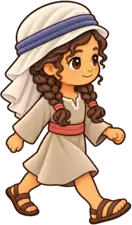
Gather resources, tend a garden, and build a home as the seasons change.
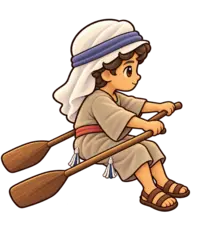
Explore the shoreline, board fishing boats and ships, and learn to steer with the wind.
Read Scripture in the game, keep track of your journey, and choose your calendar and observance path. Torah observance is central when you choose that path.
THE PC GAME · PLAYER HANDBOOK
Follow a first day in the valley, then jump to the activity you want to learn. The handbook follows the PC development build. Key labels show the usual keyboard bindings.
CHAPTER 01

Jumping. press Space to jump - a hop where you stand, or, running, a long leap that carries you forward. In the air you clear low things: fallen logs and trunks, stumps, rocks, crates, bales, baskets, pots and fences. FALLEN TRUNKS are solid: walk round them, jump them, or walk straight into one (or a low rock or a fence) and keep pushing a moment, and you climb over it - only where there's room to land on the far side, and not when you just brush along a fence. (No jumping in the water, sitting down or with your arms full.)
Running. hold Shift to run (and to swim faster). It tires you: a gold bar under you shows how much puff is left; stop running and it fills again. When you're too hungry, thirsty or tired you can't run at all - a note says which.
CHOOSE YOUR SHEPHERD (a new game): the shepherd boy, or the shepherd girl, your name - the game greets you by it - and the colours of the sash and the headband (six sets; change them any time in the bag, Outfit > Next colours). The tunic's colours come later.
Taking up a tool. a number key or a click on its slot in the toolbar takes it up (clicking the tool already in hand keeps it in hand); 0 or ` puts it away. THE PLACING OUTLINES: with the hoe, the shovel or the hammer, point at the ground - green where it can go, red where it can't (the words above the toolbar say why), even inside the garden. THE HOE'S FILL IN works on any bed - the garden's own too (it goes back to plain ground; dig it again whenever you like).
Tools in hand. the staff, the fishing pole and the net are carried in his hand; the work tools (the axe, the hoe, the pickaxe, the shovels, the rake...) are tucked away while he walks and come out in his hands when he works with them - the toolbar and the little slot by the food bar show which one is ready. With his arms full (carrying a crate or a jar) nothing else is in his hands.
The loading picture. Display > Loading picture - the shepherd with Ivory and Gizmo (the new one; the start screen shows it too, framed beside the menu), or the living valley at sunrise. WHICH BUILD: the start screen (bottom left) and the pause menu say which build of the game this is.
THE MINIMAP shows the valley as it is now: every tree as its own little picture (gone once you chop it down), and the things you build or set down outside. Click it to look at a spot, right-click to set your mark, the mouse wheel to zoom.
The land's own plants. the grass, flowers and bushes grow where they would in the land - grass, dry summer grass, anemones, poppies, daisies, lupines, mustard and thistles in the open valley with broom, sage and burnet bushes; woodland grass and cyclamen in the woods with lentisk, storax and buckthorn; rushes, papyrus and oleander by the water.
The panels. drag the status panel, the minimap or the toolbar by its dotted grip to move it. Point at a panel and click its little x to hide it (Game settings > Show these panels brings it back); V hides everything at once.
This page. Esc > How to play (or Esc > Controls > How to play, or H).
Keys. Esc > Controls > Change keys - click a key, press the new one; Usual keys puts them back. Run can be held or pressed once (run / walk), and the mouse under the water turned faster or slower, or tipped the other way.
DETAILS AND COMFORT (Esc > Display): how much grass, wind effects, fireflies, the underwater light and specks; how the camera follows, how long messages stay, screen shake.
Sizes. Esc > Display. All the panels together (50% to 130%), and each one on its own - status, minimap, compass, toolbar (50% to 160%) - so you can have a big compass and small others. The menus have their own size. Usual sizes puts them back.
The screen. Esc > Display - a window or full screen, the screen size (only sizes that fit), picture quality, VSync and frames a second.
INDOORS the room is framed between the panels. The mouse wheel zooms in; all the way out shows the whole room.
↑ Back to handbookCHAPTER 02
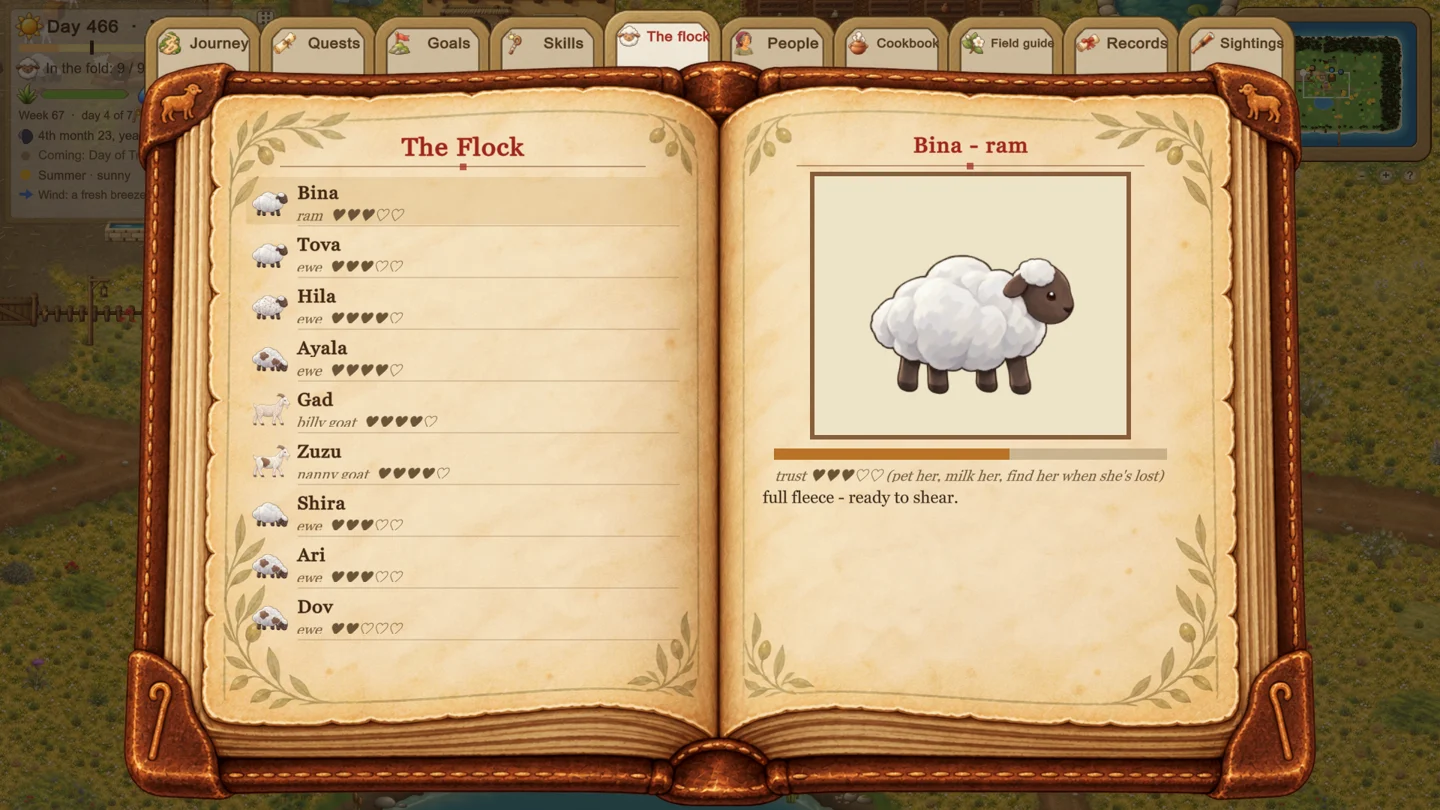
Morning: open the fold gate (G), whistle (Alt) and walk out - the flock follows you to the grass.
Hold E with the staff (1) to push sheep away from danger or back toward the others.
The dog: R sends him to gather the flock to you, Shift+R has him take them all home into the fold, U has him bring the flock OUT of the fold to graze and drink (open the gate first), X tells him to stay. More dogs join you as you level up - a second at shepherd level 4, a third at level 7 - and they take every command together, each working different sheep - and when there's only one stray, Shomer and Tova come at it from the flank beside Ivory - so the flock comes in (or goes out) much faster. The dogs run round the pond and the sea's edge to get behind a sheep; one they can't reach (across water, boxed in) they leave for a while and work another - and a fetch they can't make, they tell you.
Now and then a sheep wanders off and gets lost - follow its trail and bring it back.
Fences. a sheep or goat following you (or driven by the dog) steps over a fence INTO the fold or one of your pens, never out - once she's in, she waits for you to open the gate. FENCE LOOKS: with the fence tool, the bar above the toolbar shows the looks you can put up - woven wattle, split rails, white pickets, a dry stone wall, a thorn hedge, a reed screen, olive-wood rails, rope and posts. The stone wall takes a stone a length; the others firewood. THE GARDEN'S FENCE is ordinary fence too: take it up, add to it or change it like any fence you put up (its beds and its fence sit on the same grid as the beds and fences you add beside it).
Gates. click a fence length with the fence tool and choose "Make it a gate" (1 firewood for the hinges and latch). With anything else in hand, click a gate (or press E beside it) to open or shut it: open, the flock can go through; shut, it's a fence. The garden has one on the house side.
THE GROWING HOUSE (hammer): a timber frame glazed with clear selenite, 6 x 4 m - the Romans grew cucumbers all year in beds like these. Walk in and dig beds under it with the hoe: they grow a day faster and a watering lasts them two days. It can go up over beds you already have.
HERBS AND ROCKS to gather glow with a bright rim and golden motes; Settings > Display: "Herbs and rocks to gather glow" - Soft, Bright or Strong.
The girl. choose her on the Choose your shepherd page (a new game) - her own pictures everywhere, on land and in the water.
Pointer tips. the little note that follows the pointer can sit higher - Settings > Display: "Pointer tips: height above the pointer", and "Pointer tips while placing things" (fences, beds, buildings, things you carry) so it's never over what you're putting down.
WATER FOR THE FLOCK (the chore "Let them drink"): lead them to the pond, a stream or a trough and they drink their fill. How often depends on Game settings > the flock: CALM - one good drink keeps them watered all day; NORMAL - twice a day; LIVELY - three times.
Evening: bring everyone into the fold and close the gate before dark. Wolves, bears and lions are driven off with the staff, never killed.
Rain. in a shower the flock bunches up and stops wandering; in heavy rain or a storm they look for cover - under the nearest trees out in the valley, or their own spots under the sheep shelter and the goat shed in the fold - and stop grazing until it eases. Goats run for cover as soon as it starts. Out in the rain their wool gets wet (it looks darker); when the rain stops they give themselves a good shake. Newly shorn sheep feel the cold: they shiver and bleat in the rain and get hungry faster - bring them home under the shelter (Shift+R). Point at a sheep to see if she's wet or sheltering.
Trust. every sheep and goat has a bond with you (the hearts when you point at her). Pet her (F when you stand still beside her - once a day), milk her, find her when she's lost, keep her safe in the fold at night, and it grows: she follows your whistle longer, wanders off less, keeps calmer when wolves come, and at full trust gives an extra measure of milk.
THE DOG LEARNS by working - gathering, taking them home, finding lost sheep, chasing off wolves - and a pat every day (click him to see his training). Level 2: guards from further off. 3: Y = fetch the sheep nearest your mouse pointer. 4: guards the fold at night while you're indoors. 5: shuts the gate himself after taking them home.
Guards. the dog chases off anything hunting the flock, and so does a donkey - donkeys can't stand wolves and charge them, braying. Befriend the donkey in the western hills (feed it) and it follows you and watches a wider ring round you and the flock.
↑ Back to handbookCHAPTER 03
Watch the three bars under the day panel: food, water and rest.
Storage jars. the two big jars by your house door hold the household's barley and dried figs. F on them puts the food in your bag. They are filled again at every new moon.
Water. F at the well to drink and fill your clay jar.
Rest. sit down a while - press O to sit on the ground anywhere dry (O again or walk to get up), or F at a bench you built, by a campfire (the camp's or one you built - the fire rests you faster), at the table at home (he goes round to the bench behind it and sits facing the table), or in a booth. Rest comes back while you sit, and a little panel lets you eat and drink from your bag. Walk off to get up. In bed you can always lie down for a short rest, even when you can't sleep the night yet.
Watering the flock. you can wade a little way out into the pond (slowly). Stand in the shallows and whistle (Alt) - the sheep come down to the edge and stay to drink their fill.
Eat. open the bag (B) and press Eat on bread, stew, figs, eggs or vegetables. He takes a bite with the food in his hand - standing, on a seat or sitting on the ground. Milk, pomegranate juice and herb tea are drunk from a cup; sitting down, he drinks from it too.
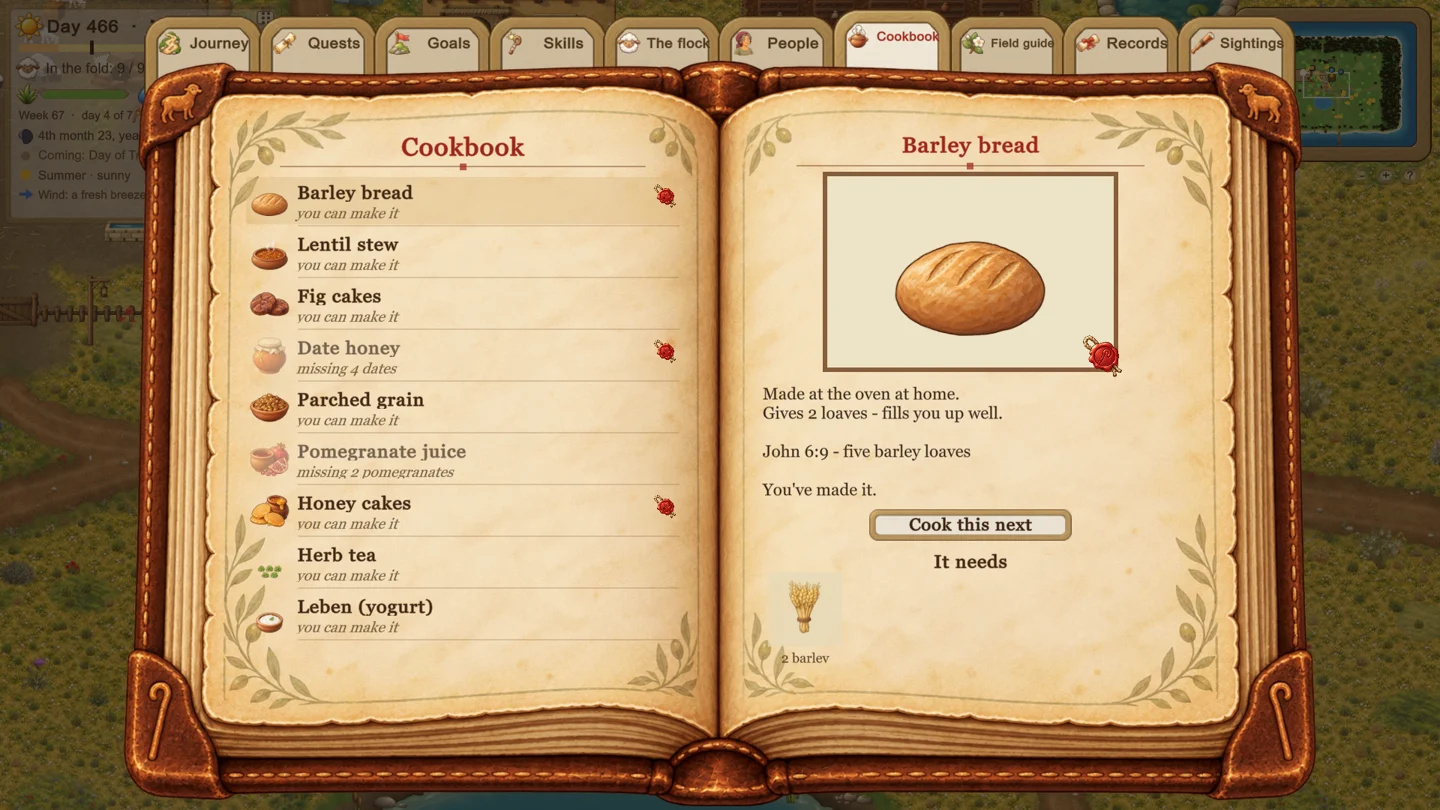
COOK at the clay oven in your house (F): barley or wheat makes bread, lentils make stew, a herb makes tea. No cooking on the day of rest - bake the day before.
Wild barley and wild wheat grow on the hillsides (they glow when ready) - F to gather grain and seed.
Rest. click your bed - sleep for the night, or just lie down and rest a while.
↑ Back to handbookCHAPTER 04
There is a fenced garden next to your house with beds ready to use, and you can dig more anywhere.
Dig. take the hoe, stand facing open ground and press E - the ground is broken up into fresh earth. Press E again (or F) to shape it into a bed.
Sow. choose a seed in your bag (B), then F on the empty bed. Herbs from the hills can be planted too.
Water. fill your clay jar at the well or the fish pond (he goes to the bank and dips it in), then F on the bed. Water from the fish pond is rich and makes the crop grow two days in one. RAIN waters every growing bed for you.
Rain. it rains as it does in the land - the first rain in the autumn, the most in the winter months, the latter rain round Aviv, and dry summers (Deuteronomy 11:14). In the morning the sky gives a hint if rain is coming. A good shower waters the garden; puddles stay a while after; now and then a thunderstorm with lightning and thunder; and after rain in daylight, look for the rainbow (Genesis 9:13).
Harvest. F on a ripe crop. Every harvest gives seed back.
REMOVE a bed you dug: hoe (5), E on it - it is filled in (press E twice if something is growing).
Beds outside the garden have no fence - put a fence round them so the flock doesn't eat them.
NEW WATER - THE SHOVEL (9): with it in your hand, three buttons appear above the toolbar - Dig a well, Dig a pond, Fill in (Z switches too). Point at the ground: a ring shows the spot and the words above the toolbar say what a click will do (green = yes, red = not here, and why). CLICK and the shepherd walks over and does it; RIGHT-CLICK always fills in (to undo a mistake). A well: dig five times in one spot (E) - on the fifth, water bursts up: a spring (F to drink and fill your jar), and a pop-up asks: build a well over it (3 firewood, 6 STONES) or leave it a spring - a spring is all you need (F: drink and fill your jar). Later, CLICK the spring with the shovel on Well to build the well. CLICK THE WELL with the shovel on Well for its menu: MOVE IT (up to 2 m off its spring - click where it should stand), ADD A TROUGH (3 wood, 2 stones - the flock drinks there; a well has none until you add one) or take it away, or TAKE IT DOWN (the spring stays, everything comes back). Among your beds the turned earth stays round a well or a pond; the hoe's Fill in on a bed leaves turned earth, and Fill in on turned earth lets the grass back. STONES: the pickaxe is only for stone. Rocks you can break twinkle; face one with the pickaxe and press E (or click it) - every third stroke a stone breaks off into your bag; rocks wear down and crumble when they're spent, and the fields turn up new ones now and then. A pond: dig a hollow (E) and water seeps in; dig at its edge to make it bigger (eight sizes). Each time, a panel asks: I'm done - finish it / Keep digging / Fill it in (F at an unfinished pond asks again). A finished pond gets reeds, stones, lily pads and flowers round it, and the next morning ducks, frogs and fish move in. FILL IN: E at a dug pond makes it a size smaller each time until it's gone; a hole, spring or well goes at once (a well gives its firewood and stones back). The hoe (5) only digs garden beds; the pickaxe only breaks rock. No digging on the day of rest.
↑ Back to handbookCHAPTER 05
Take the fence tool (6). Each length costs 1 firewood - chop trees with the axe to get it.
A see-through fence follows your mouse and turns by itself to fit the grid.
Click. put up one length (click one that's there to take it up).
DRAG in a straight line: a whole run of fence.
DRAG corner to corner: a box all the way round - the easy way to fence a garden or a pen.
RIGHT-DRAG: take up every length along it (you get the firewood back).
White = will be built, grey = can't go there, red = will be taken up.
The flock can't get through fences; you can walk through any fence - the fold's too.
Keyboard only: E puts up the length in front of you, Z turns it.
↑ Back to handbookCHAPTER 06
The hens live at the HEN HOUSE - the little thatched coop just north of the fold's north-east corner, beside the trail. Each morning they lay eggs on the ground around it; walk over them to pick them up.
EAT an egg from the bag (B).
Hatch. go into the hen house, then F on an empty nest to set an egg. A broody hen sits on it and a chick hatches in 3 days - one more hen, so more eggs (up to 12 hens).
At night the hens roost on the perch inside.
↑ Back to handbookCHAPTER 07
A NEW GAME starts small: a ram and three ewes (one of them due soon), and a buck and a doe goat (she's in milk). Grow the flock from there - keep them fed and safe in the fold and the lambs and kids come.
Your flock has a RAM (and the goats a buck). Point the mouse at any sheep or goat to see who she is: ewe or ram, a lamb and how old, with lamb and when she's due, in milk.
Lambs. a ewe that is well fed and sleeps safe in the fold may become with lamb. About ten days later her lamb is born in the night - sometimes twins - and you'll see it at her side in the morning. Lambs follow their mothers and are grown up in about two weeks. Goats have kids the same way. (Up to 60 in the flock.)
Milking. a mother is in milk for about a month after her young are born (milk her every day and she stays in milk longer). Click her (or F next to her) and she follows you - lead her into the GOAT SHED, where she steps up onto the milking stand. F at the stand to milk: a marker swings left and right - press A (or left arrow) when it's on the left, D (or right arrow) when it's on the right, left-right-left-right, and the pail fills (it stands empty by the stand until you milk; full while you finish, then the milk goes in your bag and it's empty again). Fumble and she gets restless; a full pail with no fumble gives an extra measure. A goat gives 2 milk, a ewe 1, once a day. At night, F on a goat in her stall puts her on the stand. Let a new mother keep her milk for her little one for the first few days. Whether you milk on the day of rest is your choice (menu > Sabbath and calendar).
Using milk. drink it from the bag, press Leben in the bag to sour it into leben (a thick yogurt), or press white cheese at the table in your house (2 milk). No cheese-making on the day of rest.
↑ Back to handbookCHAPTER 08
Shears. make a pair at any campfire from 1 iron ore (or 2 copper ore) and 1 firewood - ore comes from the mine (break the ore rocks with the pickaxe).
Shearing. in the warm months (months 1 to 6, from Aviv in the spring to the end of summer), a grown sheep in full fleece can be shorn. Stand still beside her and F (or click her): he kneels, she holds still, and the SHEARING SCENE opens - her fleece comes off in six BLOWS (back to belly). Press the left mouse button on a blow's green dot and draw the shears down its line (or hold F and steer with left / right): stay on the line for a clean blow; off it makes second cuts (a rougher fleece); far off it NICKS her (she flinches - four nicks and she pulls away). All six clean with no nicks = a FINE fleece, one fleece more. Esc lets her go with her wool on. Her fleece goes in your bag (a ram's heavy fleece counts two). Goats and lambs aren't shorn. A ewe in milk who is in full fleece is shorn first; after that, F leads her to the milking stand again. Point at a sheep to see her wool. A shorn sheep looks slim for a while - her wool grows back in about 30 days. No shearing on the day of rest. In the warm months the chores board shows how many are still to shear.
Spinning. at home, F at a wool basket (the one beside the loom, or one you made) and the SPINNING SCENE opens: a drop spindle hangs from the fleece. TWIRL it (left then right - A then D - or click the spindle), and while it spins DRAW OUT the fleece (hold the left mouse button on the fleece, or hold F). Keep the spin in the green: too slow while drawing and the yarn drifts apart (the spindle drops); spinning hard without drawing and it kinks. Each length is 1 yarn, 3 lengths use up a fleece, and a whole fleece with no slips gives 1 yarn more. Stop any time (Esc) - what you drew from the next fleece is kept. With no fleece the basket tells you to shear a sheep first.
The spinning wheel. build one in the house (hammer, 5 wood). It has its own seat: F at it and he sits and spins. TREADLE (left then right - A then D - or click the wheel) and the big wheel turns; hold the left mouse button (or F) to draw out the fleece while it turns. The wheel keeps going longer between treadles than the spindle does, and the yarn comes faster. The same green band, the same 1 yarn a length and the extra yarn for an even fleece. With the spinning game off he just sits and spins a while.
Mini-games up close. shearing, spinning, milking, the workbench and the loom are played in the world - the camera moves in on the real sheep, the boy kneeling, the pail filling, the bench or the loom, and the counts sit in a small bar at the bottom (the shearing cuts the wool off the sheep herself). Game settings > Mini-games > "Play them in the world, up close": untick it to play them in a panel over the game instead. For milking he walks to her side at the stand first.
HOW LONG A DAY LASTS (Game settings): 5, 10, 15, 20 or 30 minutes - or a whole hour, for the most time in the valley.
Mini-games you can turn off. Game settings has a Mini-games list - shearing, spinning, milking, the workbench and the loom. Untick one and he just does it (as quick as a click, with his own animation - shearing is the old snip snip with the wool flying): always a good result, but the bonus for playing well (a fine fleece, the extra yarn, the extra milk, a finely made tool, a fine hanging) only comes from playing the game.
Weaving. a hanging at the loom takes 2 yarn. Every new game starts with 4 yarn in the bag.
↑ Back to handbookCHAPTER 09
THE STATUS PANEL shows the season, today's weather (sunny, cloudy, rain, a storm, snowing, fog, frost...) and the temperature (a little thermometer, blue when cold, red when hot - click it to switch between °F and °C). The air is coolest at dawn, warmest in the afternoon, cooler under cloud and rain, near freezing in snow.
THE SEASONS follow the land's months: SPRING (Aviv and Ziv - lambs, the barley, shearing), SUMMER (Sivan to Elul - dry and hot, no rain at all), AUTUMN (Tishri and Bul - the first rain, the grape and olive harvests) and WINTER (Kislev to Adar - the cold rains, and now and then snow). A card shows when a season turns. The morning sky tells you when rain or snow is coming that day.
RAIN falls by the land's seasons - the latter rain round Aviv, none in summer, the first rain in autumn, the most in winter. It waters your garden; puddles gather and dry; storms bring thunder and lightning; a rainbow often follows. The flock looks for shelter (see The flock).
Snow. in the coldest months some of the wet days come as snow. The land turns white in patches and then all over - the sea, the pond and your ponds stay open - and it melts over a day or two into slush and puddles (faster in the sun or the rain). Snowflakes turn as they fall; you leave sandal prints in it, and every animal leaves its own - the flock's hooves, your dog's and cat's paws, the hens' and ducks' three toes, the donkey's round hooves, the wild ones' tracks; your breath (and the animals' near you) puffs in the cold; when it lies thick it drifts up against the house, the barns, the fold's walls and out on the open ground, and snow settles on top of everything standing out in the valley - the trees, the bushes, the flowers and tall grass, the roofs, the fences, the rocks and all you've built - and melts off with the rest. When the pond freezes the ducks climb out and waddle about on the ice. THE SNOW SHOVEL (make it at a workbench: 3 wood): E clears the snow in front of you - the path stays clear till new snow fills it - and each scoop puts a bowl of clean snow in your bag (up to 12). In the bag: SNOW CREAM (a bowl of snow, a cup of milk and a little honey - then Eat), or pack 3 SNOWBALLS - Throw, then click where: it bursts in a puff, your dog races after it and a sheep it lands by jumps. With the hammer, build a SNOWMAN (3 bowls) or a SNOW LAMB (2) while the snow lies - they melt away in the thaw, and so does the snow in your bag. The sheep find little grass under the snow - keep them fed and near the fold. IN THE RAIN the puddles fill - clear water showing the sky - and walking through one splashes: you, the flock, your pets and every other animal.
The sea. the open water is painted - turquoise, its swells always gently moving, the sun glinting on it. On a calm day that is all; in a strong wind, a rain squall or a storm, white wave crests ride the swell the way the wind blows, more and bigger the rougher it gets, and little waves roll in to the beach. A sandy beach runs right round the island; at its edge the clear shallows begin and the surf washes up.
Ice. on the bitterest nights (in Tevet, and when it snows) the pond and your ponds freeze over, and they thaw when the cold eases. You can walk out on the ice - it's slippery! - but not swim. Out on the ice, moving along, you SLIDE (arms out, feet together); landing a jump on it, or running, CRACKS the ice with a creak (the cracks go at the thaw). ICE FISHING: first cut a hole with the ICE CHISEL (make it at a workbench, then CLICK the ice where you want the hole - he walks over and chips till it breaks through, three strokes - or E on the ice in front of you), then take the pole (3) and cast at the hole: the fish bite through it (the net can't go through ice).
Through the year. in SUMMER the grass dries to gold, greening again after the first rain. In AUTUMN the leafy trees (figs, almonds, pomegranates, terebinths and some oaks) turn gold and russet, leaves flutter down from them and tumble on the wind (lots of them) and lie under the trees; from the middle of Tishri they PILE UP under about half of those trees - rake a pile up (the rake, E) for 3 armfuls of leaves for the compost bin, walk through one and the leaves scatter, jump into one (Space) and they fly; in WINTER those trees stand bare and grey (once their paintings are in, they really do lose their leaves: half bare in late autumn, bare in winter). In SHEVAT the almond trees wake first, white and pink with blossom (Jeremiah 1:11), and petals drift on the wind. Olives, carobs, palms and tamarisks stay green all year.
Rain on the water. the drops ring the water where they land - the pond, the sea, the ponds you dug and the fish pond by the garden. Jump into a puddle (or climb over something into one) and you land with a big SPLASH. The FISH POND freezes over with the big pond in the bitter cold - the fish wait under the ice till the thaw (fill your jar at the well). SNOW: with the snow shovel in your hand, CLICK the snowy ground and he shovels a path from there, on and on the way you sent him, like the pickaxe on a rock - click again (or walk away) to stop; E shovels right in front of you; CLICK A SNOW DRIFT (the heaps by the house, the fold and out in the open), or press E at one, and he digs it out - three strokes, smaller each time, a bowl of snow each - the drifts pile up again with the next snow. A SNOWMAN or SNOW LAMB (the hammer): he kneels and gathers the snow, and it grows from a heap into the whole figure; in the thaw it melts slowly - slumping, dripping, a little heap - over a minute or so, not all at once, and leaves a puddle that dries up. Shovelled snow flies white, and chipped ice glitters (not earth). In AUTUMN, click a leaf pile with a rake on your belt and he rakes it up (3 leaves); without one he kneels and scoops up 2 by hand. A pile left lying into the winter can still be raked.
FROST whitens the grass on cold, clear nights and mornings in the cooler months, and on some still mornings from autumn to spring MIST lies in the valley until the sun climbs.
↑ Back to handbookCHAPTER 10
Take the fishing pole (3) or the net to the water and press E (or click the water).
With the pole: wait for a bite, then hold to reel in; let go when the line gets too tight. Land it and it hangs from your line, wriggling, before it goes in your bag.
With the net: throw it right over the dark shapes of a school. A card shows the haul - each kind of fish, its picture and how many - at the top of the screen once the fish have leapt.
In the coldest weather the pond freezes - fish through a hole in the ice (see Seasons and weather).
Fish are never eaten here. Carry them home alive and F at the fish pond beside the garden to let them go in. The more fish live there, the more rich water it gives each day for the garden, and they slowly multiply.
↑ Back to handbookCHAPTER 11
F at a door to go in; walk out through the doorway to leave.
Your house. a big cedar house. The main room has the clay oven (bake bread, cook stew, brew tea) and the stone hearth (sit and rest by the fire), the table with the Sabbath candles, the Scriptures on the reading stand under the window, the loom, and the storage jars by the door. Past the cedar wall on the right is the sleeping room: the bed (sleep) and the chest (your bag). Lamps are lit in the evening. He walks past the furniture inside (it never traps him). Moving a piece inside with the hammer happens straight away where you click. THE LOOM: walk up to it (F or click) and weave a hanging (it takes 2 yarn - see Shearing and wool) - a Name (Yahuah, Yahusha, in English or in Hebrew letters, Elohim, Shalom, HalleluYah, Emet) or a design (diamonds, bands, the menorah, pomegranates, the lion and the lamb, the Lion of Judah, sheep), in the wool colours you pick. Press F (or Space, or click) each time the shuttle reaches the green end; then hang it on one of three spots on the walls (a hanging that was there is rolled up and kept - the loom can hang it again). Click a hanging on the wall to see it up close, to roll it up (kept) or to move it to another spot. ROLLED-UP HANGINGS are listed in your bag. HANGING ONE (after weaving, Hang in the bag, or Move it on one already up): point on a back wall and click - the house, the upper room, the work shed, the stable, the sheep shelter or the hen house, as high or low and as close together as you like (a green outline: it fits; red: a window, a shelf or another hanging is in the way). Esc keeps it rolled up (or, moving one, leaves it where it was). To hang one in another building, go there and press Hang in your bag. WALL SHELVES go wherever you point on the wall too - higher, lower, side by side or one above another. No weaving on the day of rest.
Goat shed. the goats rest in their stalls at night and on the Sabbath - F to pet them.
SHEEP SHELTER (in the fold): at night and on the Sabbath the flock lies resting in the straw - F to pet them.
Hen house. the nests and the perch.
Carry things. F on a jar, pot, crate, basket, bucket or log seat picks it up; F again puts it down in front of you - outside or indoors.
↑ Back to handbookCHAPTER 12
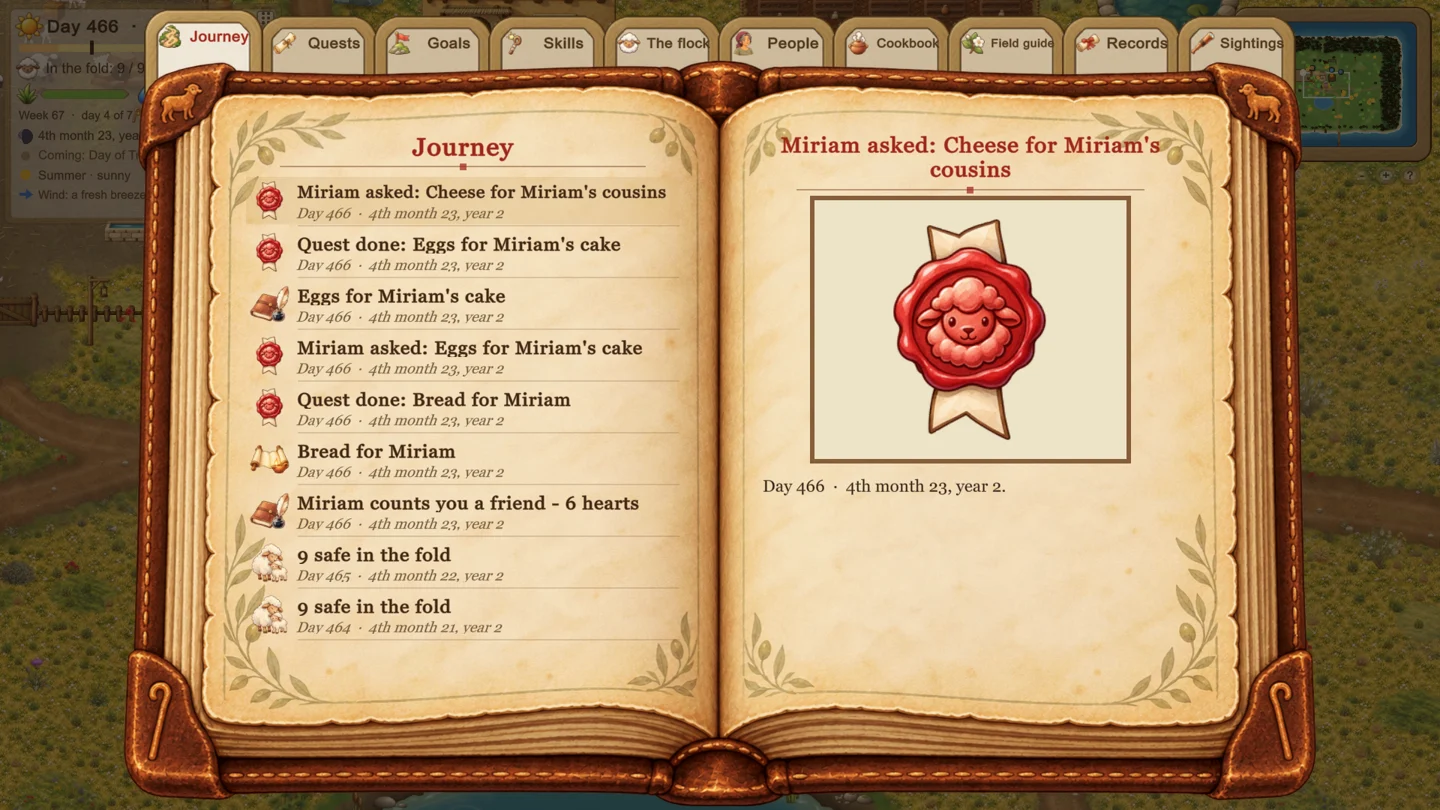
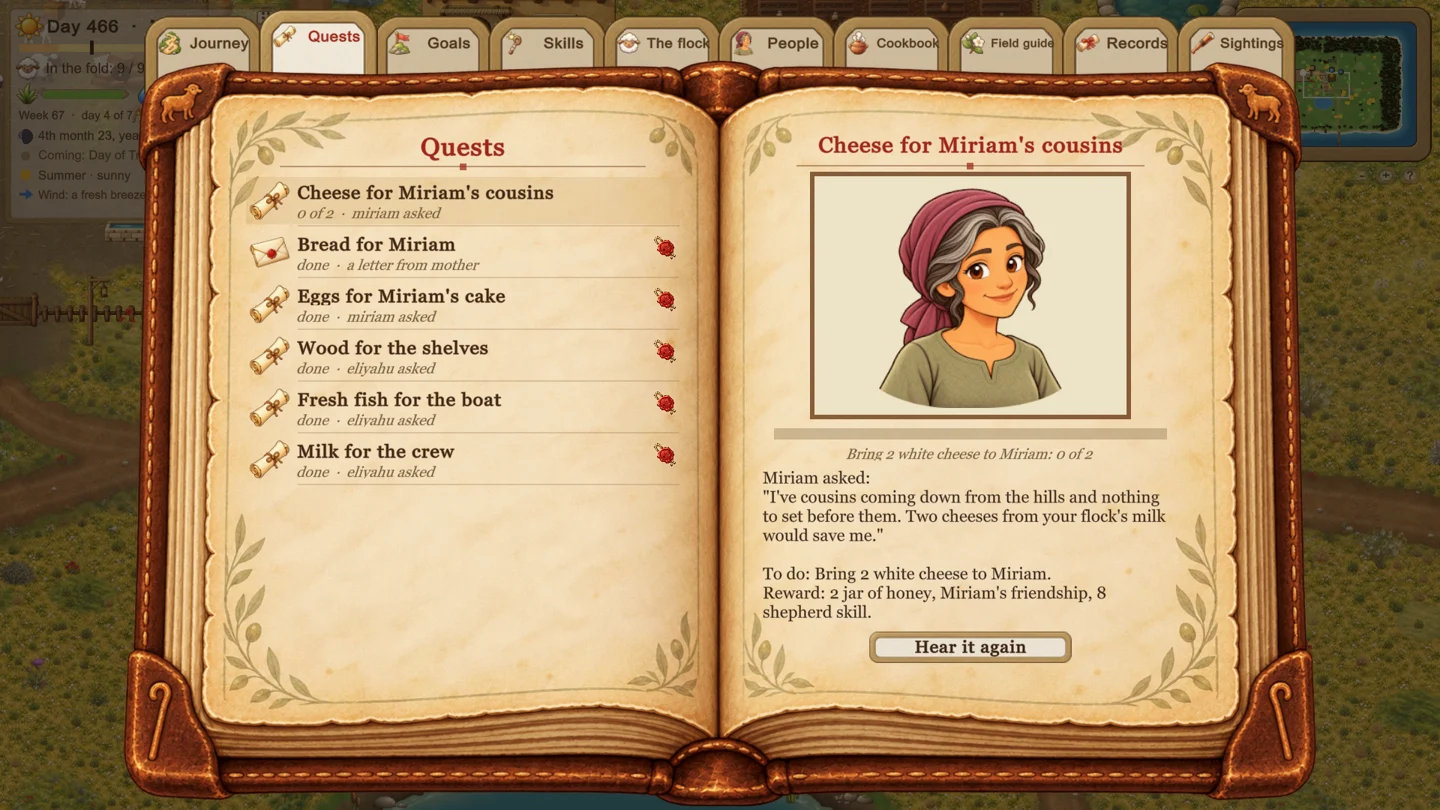
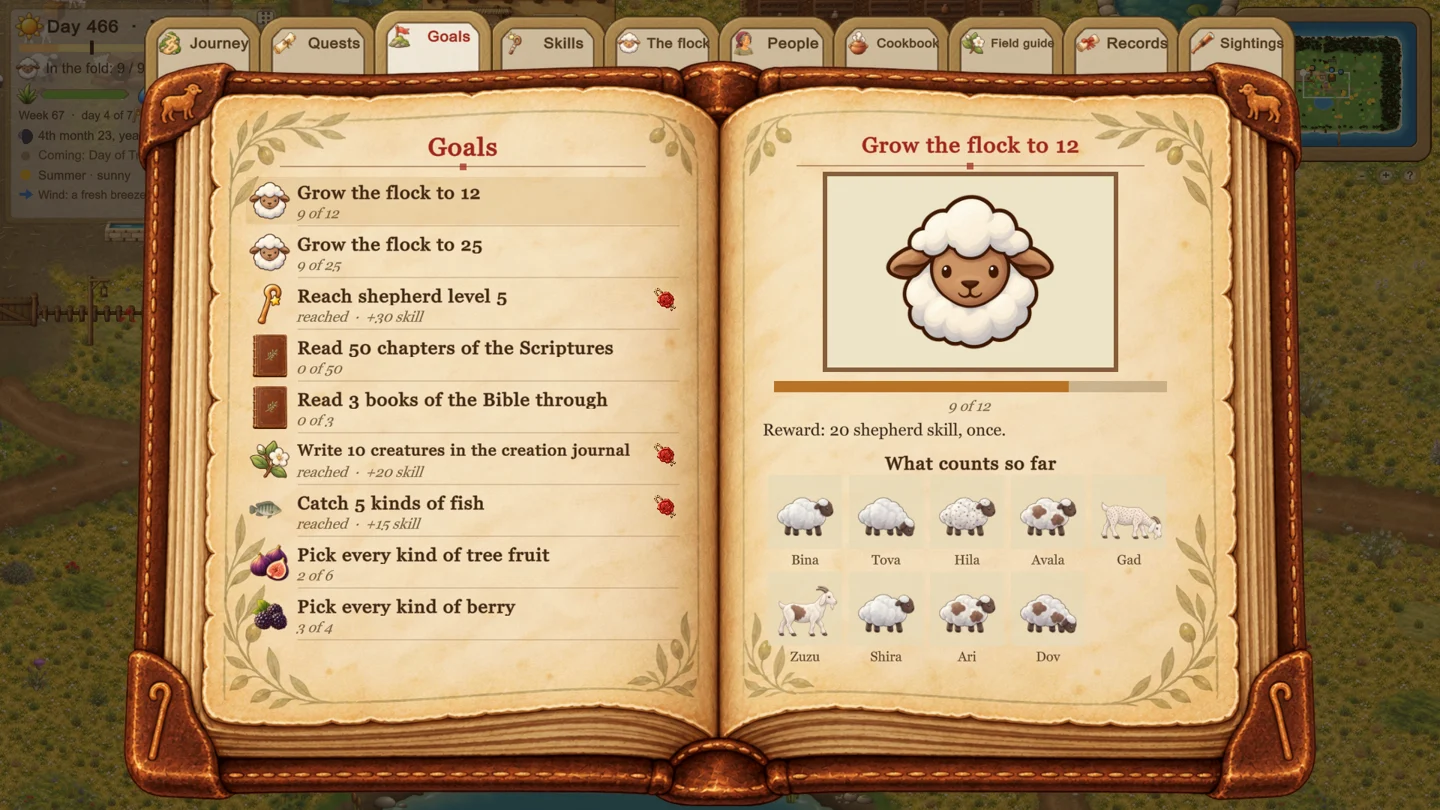
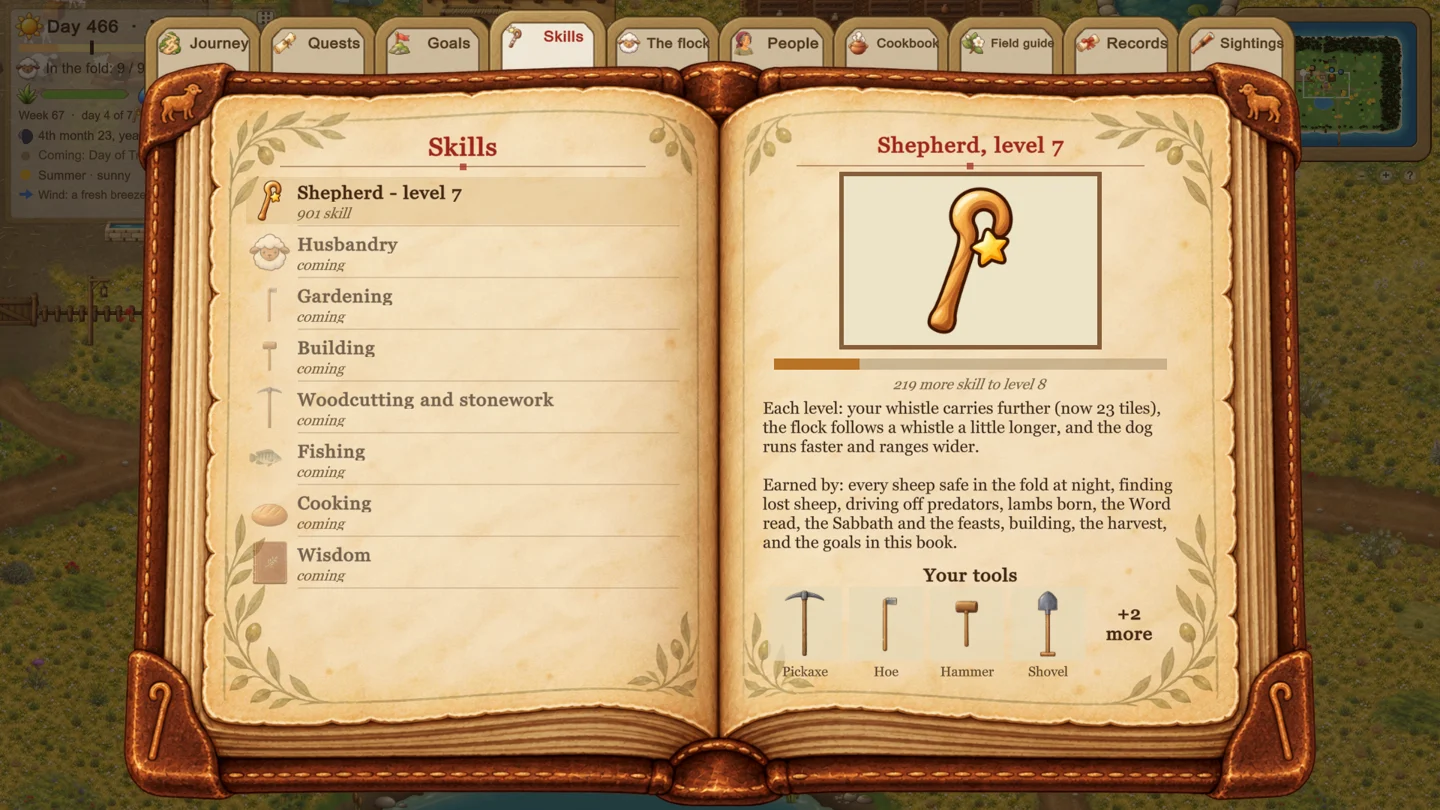
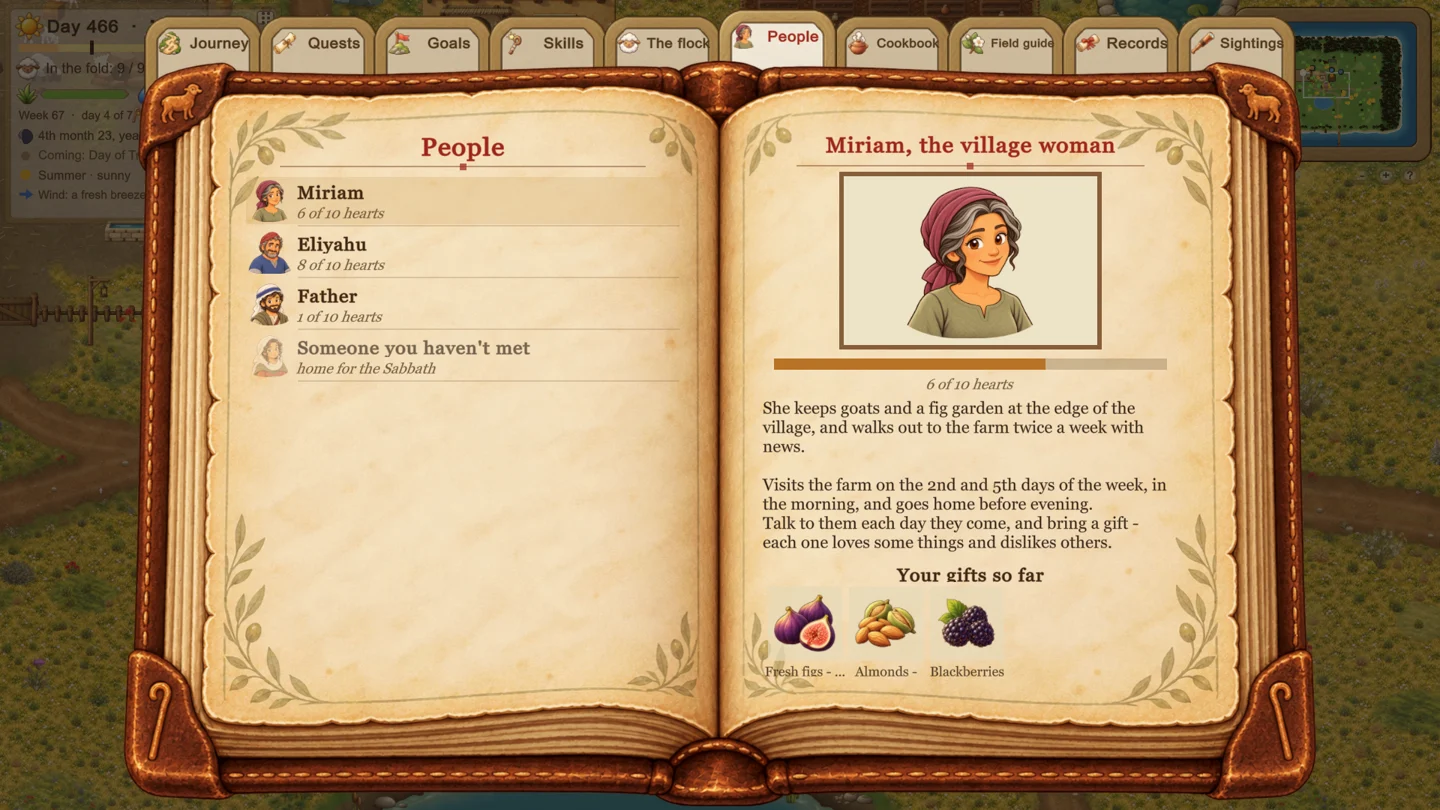
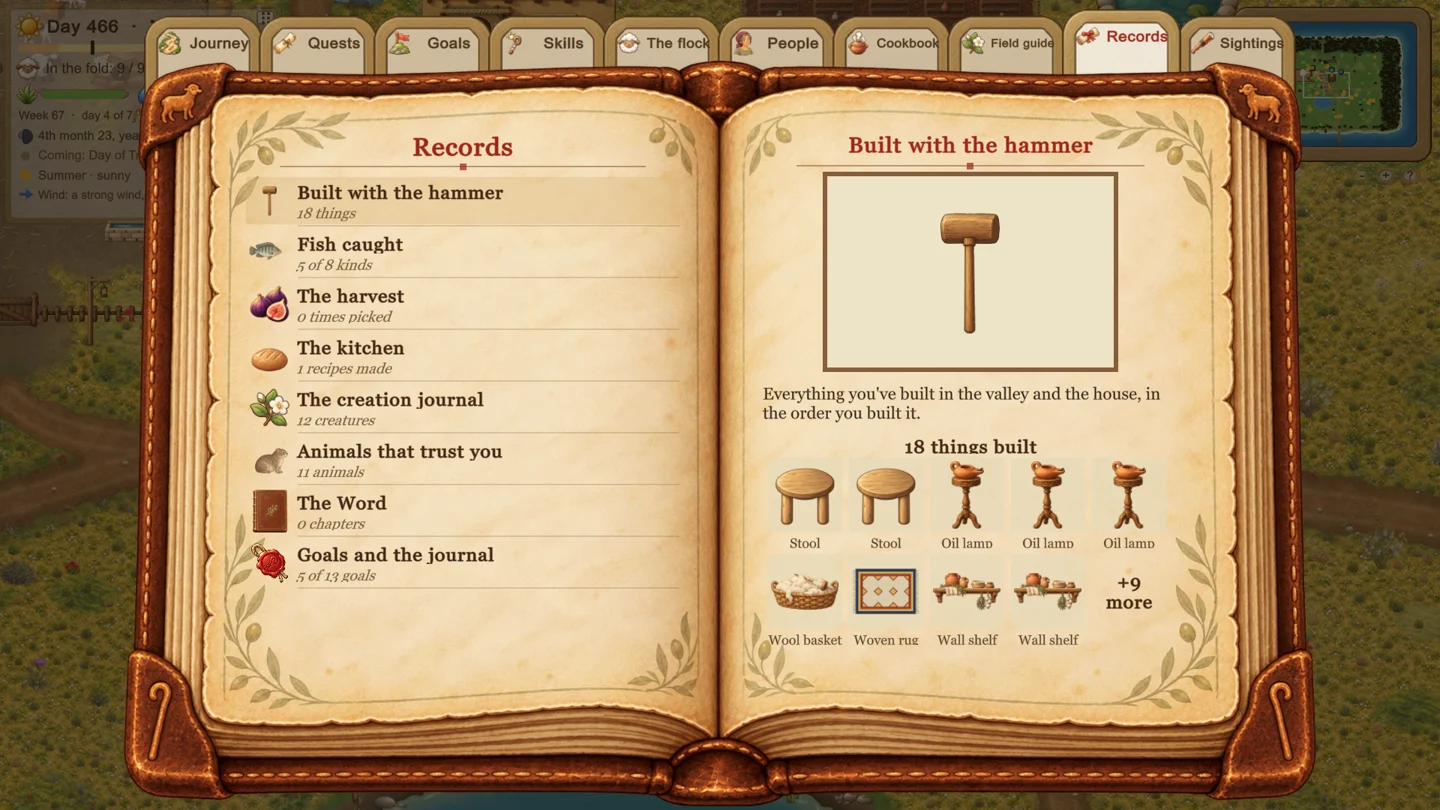
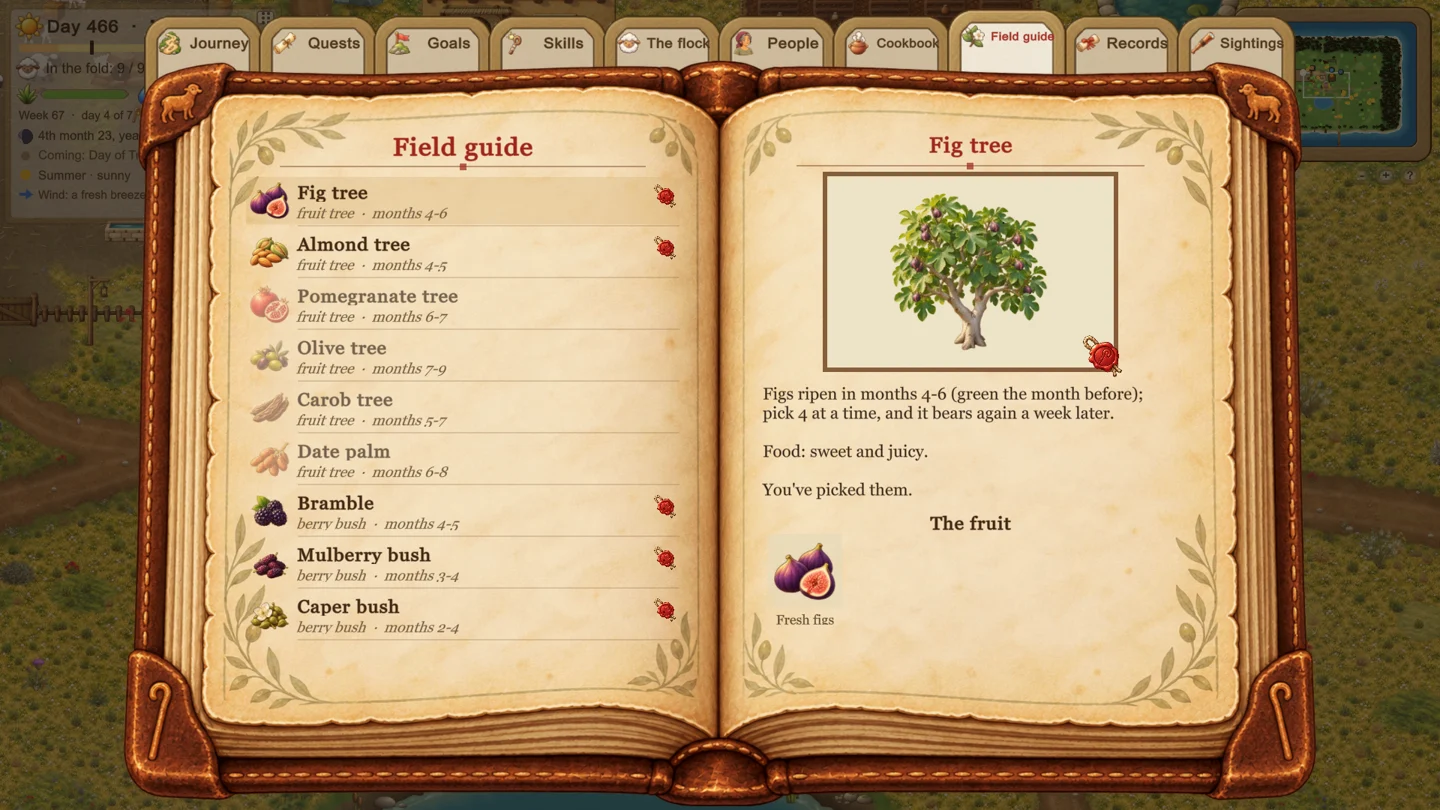
The keeper's book. your own book - press F1 (or the pause menu's button; change the key in Controls > Change keys). Each tab is an index and a page: the LEFT page lists everything with a little picture - click a line (or W / S) and the RIGHT page shows it in full, with a big picture, every detail and pictures of what counted (each thing you built, each fish, each fruit, each creature). A / D (or Previous / Next) turn the pages - the leaves turn over. JOURNEY: a journal the game writes as you go (lambs born, lost sheep found, wolves driven off, levels, first harvests, first recipes). GOALS: milestones with progress bars - each one reached gives shepherd skill. SKILLS: your level and what the next brings. THE FLOCK: every sheep and goat with her hearts, age, milk and fleece. COOKBOOK: every recipe, what it needs and where it's made - 'Cook this next' and the oven at home makes that one (new: fig cakes, date honey, parched grain, pomegranate juice, honey cakes). FIELD GUIDE: the fruit trees and berry bushes (when they bear), herbs and fish. RECORDS: fish, the Word, the creation journal, the harvest. A / D turn the pages.
People you talk to. MIRIAM, the village woman, visits on the 2nd and 5th days of the week, ELIYAHU, the village man, on the 3rd and 6th, and FATHER and MOTHER come home for the Sabbath - each in the morning, by their spot (Miriam by the well, Eliyahu by the campfire, your parents by the house), going home before evening. Walk up and press F (or click them): what they say shows in a BUBBLE over their head and in the TALK WINDOW - their portrait, their name and friendship hearts. F (or a click) shows the words at once; then 1 Talk, 2 Give a gift (pick from your bag with 1-9 or a click), 3 Goodbye (Esc too). Talking each day they come and a gift each day win their friendship: 0-10 hearts; each loves some things and dislikes others - the Keeper's Book's PEOPLE tab shows their hearts, when they come and what they thought of your gifts. Walking by, they may say a word. Esc > Game settings > Talking: the bubbles, the talk window and the passing remarks each on or off, 10 bubble looks, 3 window looks, how fast the words appear and the bubble size.
↑ Back to handbookCHAPTER 13
Board your own boat with F at the jetty. From the water, swim alongside and press F to climb aboard. On tall ships this takes you to the rope ladder. Walk on deck with W/A/S/D.
At the stern, press F to take the tiller or steering oar. Use A/D to steer and W/S for more or less sail. Sailing across the wind is fastest. If you stop head to wind with the sail idle, hold W to row and steer clear. Hold Shift for more speed at the cost of stamina. Press F to release the helm. Use Space aboard to jump over the side.
If a steerable ship is pressed against a pier, hold a movement key to pole it free. If you are stranded offshore, use Call a boat to take you in when the rescue prompt appears. It takes you back to the wharf.
The harbour. the WHARF - with the hammer (8), choose Wharf and point near the water's edge of the SOUTH BEACH: its stone landing snaps onto the sand and the wharf stands out in the sea in front of it (green where it fits; it needs open sea under it, and room beside the jetty, the big dock and the slipway). Z (or Turn) puts it the other way round - the house and the steps on the west or the east. Built in 4 stages - the oak piles, the beams, the planks, then the edges, the landing and the stone steps (42 wood, 16 stones, 8 oak in all). Walk out along the landing and about on it, fish from it, step off into the sea; swim to its edge to pull yourself up, or walk up its steps. Then choose HARBOUR HOUSE: it goes in its place on the wharf, built in 4 stages too (18 wood, 44 stones, 4 oak). Go in at its doors: the SHOP. ELIYAHU keeps the store there every day but the Sabbath, morning till evening - talk to him at the counter and choose TRADE: no money, goods for goods (fleece, yarn, cheese, fish, honey, candles, eggs, milk, figs, shells... for salt, iron, olive oil, lamp oil, dye, dyed cloth, nails, seed and oak). 8 trades at a time, each 3 times. THE TRADING BOAT ties up at the wharf on the 3rd and 6th days of the week, morning till early afternoon, and brings fresh goods each time. You can walk aboard the trading boat while it's tied up. At dusk the beacon on the wharf is lit. Once the harbour house stands, FISHING BOATS lie at anchor out at sea and sailing boats go along the coast by day. The visitors have a bite of bread now and then, and at midday sit down on the ground to eat. SIZE: click the wharf with the hammer - Wider / Narrower (3 to 6 bays, 12-24 m) and Further out / Not so far out (2 or 3 rows, 8-12 m); each new 4 x 4 m section costs 10 wood and 2 oak, given back when you make it smaller. The HARBOUR HOUSE can stand anywhere it fits on the wharf, and turns (Z): the crates, barrels and lanterns are set round it. MOVING anything: click it, Move - it lifts off its spot (highlighted) and goes with the pointer; click to set it down. Swim under the wharf: its piles go down to the sea floor, the planks overhead. The boats at sea keep apart and off the rocks; now and then a fishing boat ties up at the wharf's steps for a while, and while the trading boat is in, its gangplank is down and a sailor carries sacks to the harbour house. In the shop Eliyahu stands behind the counter; walk up to it and talk (a click on him works as well as F, #308). The wharf's single CRATES, BARREL and FISH BASKET are like the farm's: click one (or F) for the little menu - Pick up, Break open - and carry it, set it down on the boards or throw it. PUSHING: walk into the crate stacks, the barrels, the sacks, the jars or the rope on the wharf (or the barrels and sacks in the shop) and you push it along the boards - it stays where you leave it; they're never set down on the walkways to the house's doors and the steps. A PORTER comes out from behind the harbour house when a fishing boat ties up at the steps (2 or 3 loads of the catch) or the trading boat comes in (6 sacks), carries them round into the house and goes back out of sight. VOICES: the people speak their words (Miriam, Eliyahu, Father and Mother), and in the book a Scripture reading has READ ALOUD - read in your shepherd's own voice, turning the pages as it goes; Settings > Talking > Voices turns them off, and Sound has a Voices slider. Fruit trees and berry bushes you've picked stay picked when you save and come back. The boats turn through 16 directions round the compass, and the sailing boats round the island have a crew. The people's mouths move with their voices; the talk window shows how they feel (glad, serious, disappointed) when ChatGPT's faces are in. The trading boat's sailor carries its sacks into the harbour house; at dusk a boat at the steps rows out for the night. Someone you're walking over to talk to won't start a passing remark first. A turning boat's picture blends smoothly from one direction into the next instead of changing, and the boats come round more slowly. QUESTS AND LETTERS: letters from Mother and Father come on the trading boat (the 3rd and 6th days), one at a time - Eliyahu keeps it for you at the harbour house (a letter shows over his head): ask him "A letter for me?" - each asks something (take bread to Miriam, build something, read the Word, trade at the harbour...). Read them in the Keeper's Book (F1) > Quests, or hear them read. Ask Miriam or Eliyahu "Any work for me?" in the talk window for jobs; bring what they ask and choose "Here's the ..." to hand it over. Rewards: things for your bag, their friendship and shepherd skill. The quests in hand show in a box under today's chores (click it for the Book's Quests page, now the 2nd tab). Out at sea there are a dozen boats all round the island, two of them big ships. WHEN: Eliyahu keeps the store every day but the Sabbath from morning till the end of the evening; the boats are out from early morning till dusk (at night they are in); the porter works by day when a boat is in; the trading boat comes on the 3rd and 6th days. The boats come about by swinging round to face you and on round the other way, keep well clear of the jetty, the big dock, the slipway and the wharf, and the big ships keep their distance from the little boats. Swim to the tied-up trading boat side and he climbs aboard. The boats really sail now: they steer in curves and come about slowly, take long passages round the island, and the fishing boats leave the harbour in the morning, go out to their fishing grounds at sea, fish a while (making the net ready, throwing it, letting it sink, hauling it in, resting), move on, now and then tie up at the wharf, and come home at dusk.
Boats at sea. every boat - the fishing boats, the trading ships and the big ship - is a real 3D model turned live, so it turns smoothly at any heading, with its painted people in it: two fishermen to a boat (one rowing, one at the stern, hauling the net over the side when they fish), the sailor at the helm and the deckhand on the ships. Moving boats leave a wake: the V of white water parting from the bow along their sides and the churned water behind. Only the trading boat comes in to the wharf. The others each keep to a lane of their own round the island - the fishing boats closest in, then the two sailing boats, then the two big ships furthest out (see them at the edge of the view, or through the spyglass) - and every lane swings well out round the wharf, the docks and the jetty. The fishing boats lie off out at sea for the night. Game settings > Boats at sea drawn from their 3D models turns it off (the painted boats).
The trading boat. it is a real ship now - it sails in from the open sea round the wharf, the docks and the jetty on its days, ties up alongside the wharf with its crates and barrels on deck (fewer as the porters carry them in), and sails out again in the afternoon. Its hull is solid when you swim; tied up, walk aboard from the wharf. All the boats keep clear of each other: they steer round early, and the one that must give way slows down.
Aboard a boat. swimming on top of the sea, the boats are solid - swim up beside one and press F to climb aboard. You ride along on its deck wherever it sails (sitting in a fishing boat, standing on the ships). WALK THE DECK: W/A/S/D walk you about it - bow to stern, side to side, up the steps onto a ship's raised stern deck - kept off the rail, the masts, the helm post, the open hatch and the trading boat's cargo, carried along as she sails. YOUR OWN BOAT: a fishing boat of your own is tied up beside the little jetty, day and night - walk out along the jetty and press F beside it to step in. JUMPING OFF: F or Jump - you step to the rail and jump off over the side, feet first into the sea, from the side you're standing by (or the side toward you). CLIMBING ABOARD: from the water you grip the rail, swing a knee over and climb in on the side you swam up to. SAILING: walk to the stern - the tiller of a fishing boat or your own, the steering oar up on a ship's raised stern deck - and press F to take the helm. A / D steer her to port and starboard (left and right as she goes), W lets out more sail, S takes it in. The wind matters: sailing across it is fastest, with it behind you a little slower, close to it slow, and straight into it the sail does nothing and she slows to a stop - then hold W and, in a fishing boat (or your own), he takes to the oars for a few seconds to get her going and turn her off the wind, then goes back to the tiller and sails (a ship just stops: steer her off the wind). Hold Shift to haul hard on the sail (or the oars) - half as fast again, using your stamina like running. You can't sail into the land, a rock, a pier or another boat (she stops - S backs her off); the open sea goes on as far as you like. On the ships walk aft and up the stairs (one each side, port and starboard) onto the raised stern deck - the decks' walls can't be walked through - and press F anywhere up there to take the helm (an "F take the helm" sign shows over you wherever you can) - or press F at the foot of the stairs and you climb them to the helm yourself (the sailing boats and the trading boat too: their stairs are on the starboard side, toward the stern). Out past the map's edge the camera keeps with you, however far you sail. If she runs against a pier, a rock or the shore and sticks, hold any key: the crew pole her off (in your own boat you push off with an oar). Aboard, the sails of your boat fade see-through so you can see the deck under them. FAR OUT AT SEA: swimming 15 m or more off the coast, a "Call a boat to take you in" button shows - the nearest fishing boat sails out to you, the fishermen pull you aboard and take you in to the wharf, where you step ashore (jump off or take the helm to call it off). You can't sit down in the sea: keep still and you tread water, which gets your rest back slowly. Climbing aboard a ship from the water you climb its rope ladder amidships. THE WIND: the status panel's wind row shows how strong it is and where it comes from, with an arrow the way it blows; at the helm a gauge over your boat shows the wind's arrow and how well the sail draws - Fast (across the wind), Good, Slow (close to it) or In irons (straight into it: turn off the wind) - a mark for how much sail you have out, and her speed in knots and the way she's heading. A boat can't sail straight into the wind: zig-zag across it. In a fishing boat the yard and sail swing round the mast to meet the wind as you turn - square across with the wind behind you, braced round with it on your side. F lets go: on a fishing boat or a ship the crew take her back to their way; your own boat drifts to a stop where you leave her - bring her back beside the jetty and let go there to tie her up. The trading boat at the wharf keeps to its master's timetable, so it isn't yours to steer.
The big dock and the slipway. built with the hammer on the SOUTH BEACH - the same shore as the little jetty, either side of it (at least 6 m along). Choose Big dock (or Slipway) and point near the water's edge of the south shore - the outline sits on the edge by itself and shows it going straight out into the open sea, green where it fits, red (and why) where it doesn't. THE BIG DOCK: a pier as long as the sea there lets it be (up to 16 m) - the stone abutment and steps (14 stones), the oak piles (6 oak, 4 wood), the beams and joists (12 wood), the planks (16 wood), the far end with its T, mooring post and ladder (12 wood). Walk out on it and fish from the end. THE SLIPWAY: the ramp a boat is built on (the shipwright comes later) - walk down it into the sea: dry at the top, wading deeper toward its end, and you swim only past its end or off its sides - the stone bed (20 stones), the sleepers (12 wood), the rails and keel blocks (8 wood, 4 oak). One of each. MOVE either one later like any building (hammer, click it, Move) - its old spot doesn't get in the way. Once you've placed a moved thing, the mouse shows no building preview until you pick something in the build menu (or take the hammer up again). SWIMMING up to the big dock, the narrow pier's sides and piles stop you: swim round to its wide end (the T) and swim at its edge - he springs up out of the water onto the planks in one hop - the little jetty the same, from its sides or end. The dogs keep to the middle of the planks (and back from the little jetty's end, #278), and a dog that ends up in the water paddles straight out. Walk off the edge to get back in. Under the water you see the dock's piles and the ladder's rails, and swim between them. You can't cast onto the dock or the slipway - cast into the open water beside them; a hooked fish can't take your line under the dock, and the net is lifted over the planks as you haul it in.
↑ Back to handbookCHAPTER 14
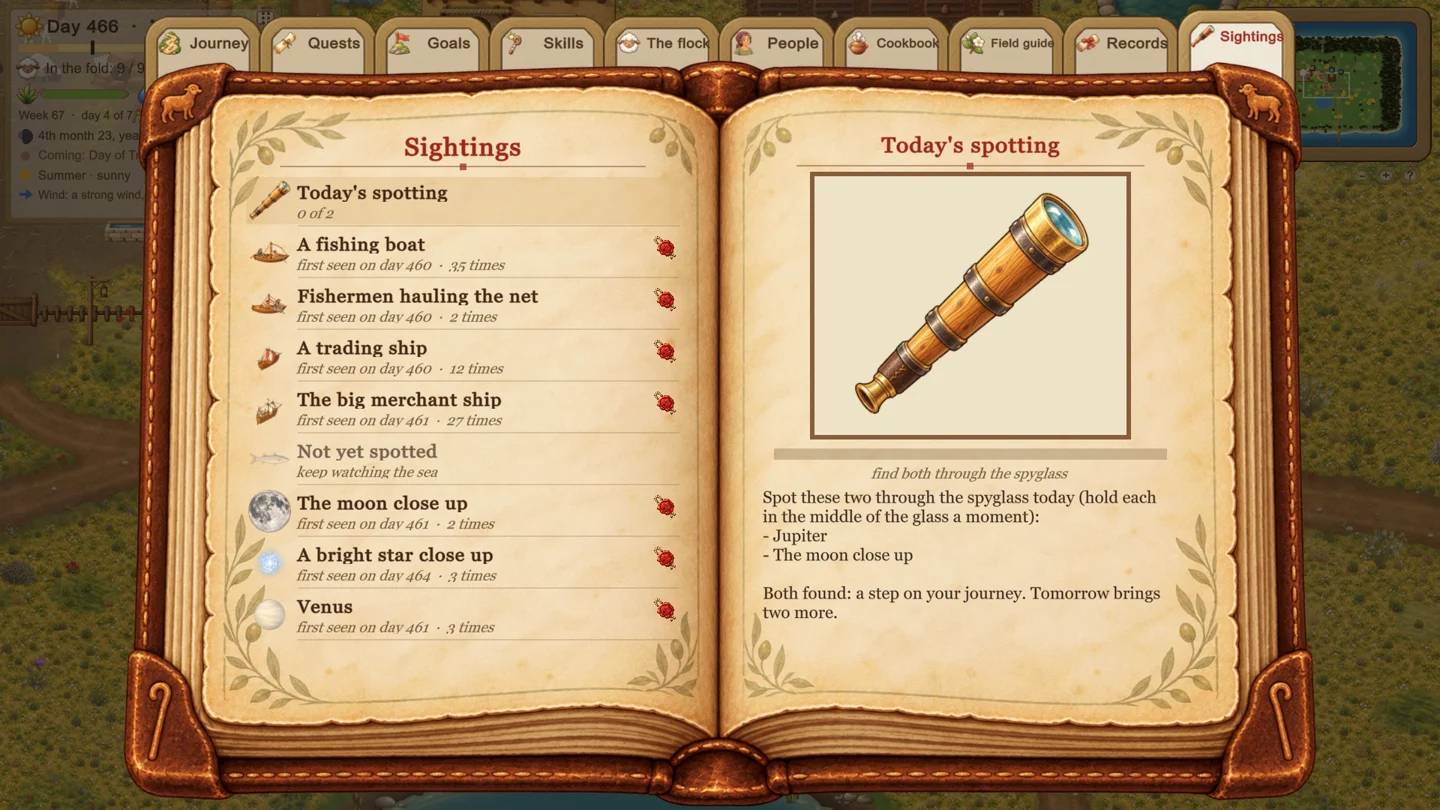
The spyglass. make one at the workbench - the sighting tube (2 wood, 1 crystal), then the copper spyglass (2 copper ore, 2 crystals and your sighting tube), then the fine spyglass (2 iron ore, 3 crystals, 1 oak and your copper one) - or trade for one at the harbour house when the boat is in. It goes on your tool belt: take it in hand and press E (or click) to raise it. The pointer is held in the middle of the glass: move the mouse (or W/A/S/D) to look round - out to 60 / 110 / 180 m - as far as the map goes - and the wheel brings things closer or further, quickly (up to 2x / 3.5x / 5x). Along the top a compass shows which way you look; below, what is in the middle and how far off, the glass's power and how far out you are looking. How fast the mouse swings it: Game settings > The mouse (the camera drag, the swimming mouse and the sky have their own). Each boat in the glass is labelled with what it is and how far off. Hold a boat or a leaping fish in the middle a moment to SPOT it: each new kind is written in the Keeper's Book (Sightings) with the day you first saw it - a step on your journey - and each day there are two things to spot. E, Esc or right-click lowers it. THE SKY THROUGH IT: lie back (L) and press E - or press L with the glass raised over the sea - and you look up through it: the mouse swings it, the wheel brings the sky closer. The moon's face in its true phase, the named stars as small fierce lights in their own colours, shimmering in the air, and the seven wandering stars - Mercury, Venus, Mars, Jupiter, Saturn, and through the glass Uranus and Neptune - each in its true place that night (Venus and Mercury show phases like little moons). Hold one in the middle to spot it for the Keeper's Book. E puts the glass down; L or Esc gets up. LOOKING OUT TO SEA: L with the glass raised looks OUT the way you were pointing it, at the horizon - the open sea where there is no land that way, the hills where there is, land across the water low and hazy - and the boats out there seen from the side, smaller the further off (hidden behind the land), each with how far off it is. Move the mouse down to look at the sea, up for the sky; hold a boat in the middle to spot it. Aboard a boat it goes with you, so you can watch for land as you sail.
↑ Back to handbookCHAPTER 15
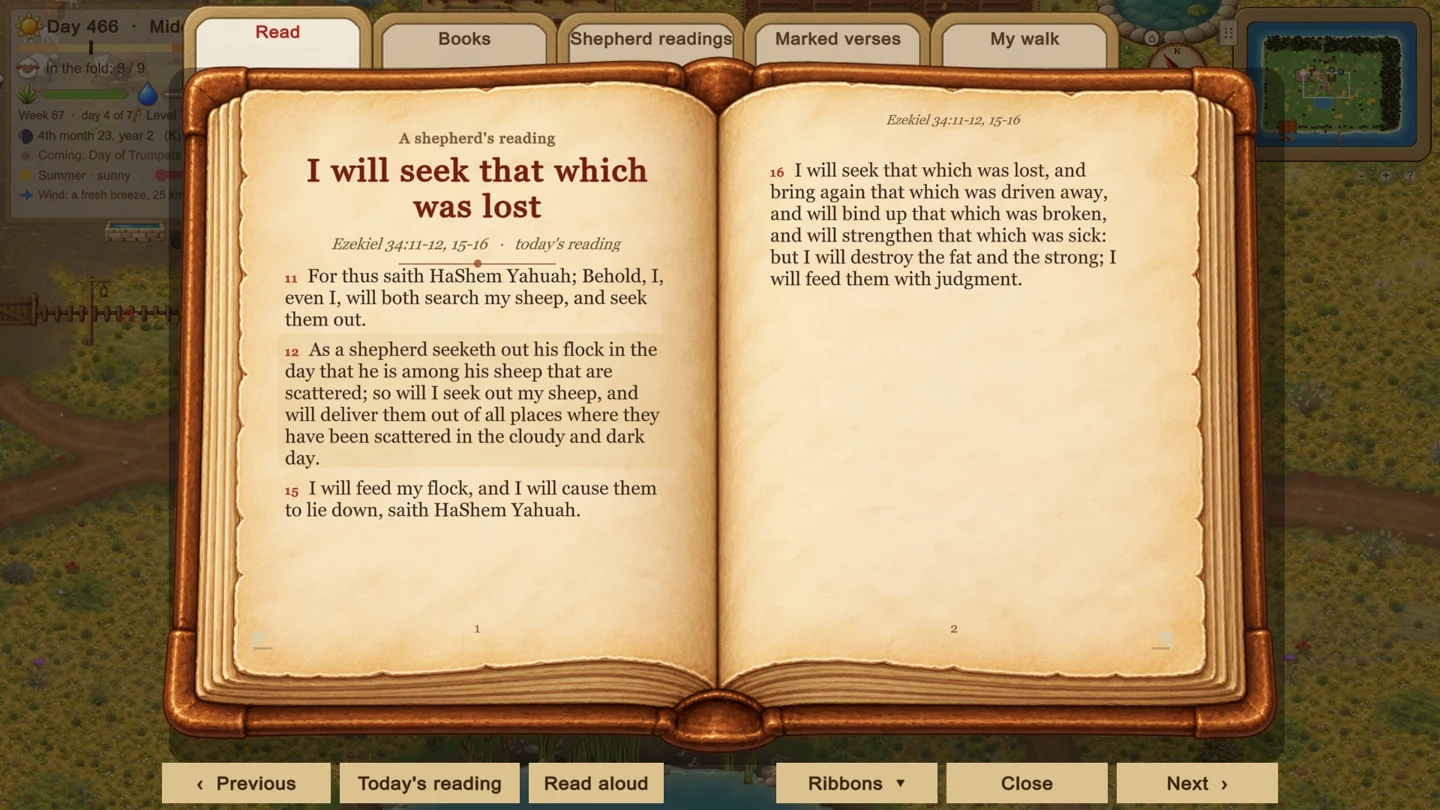
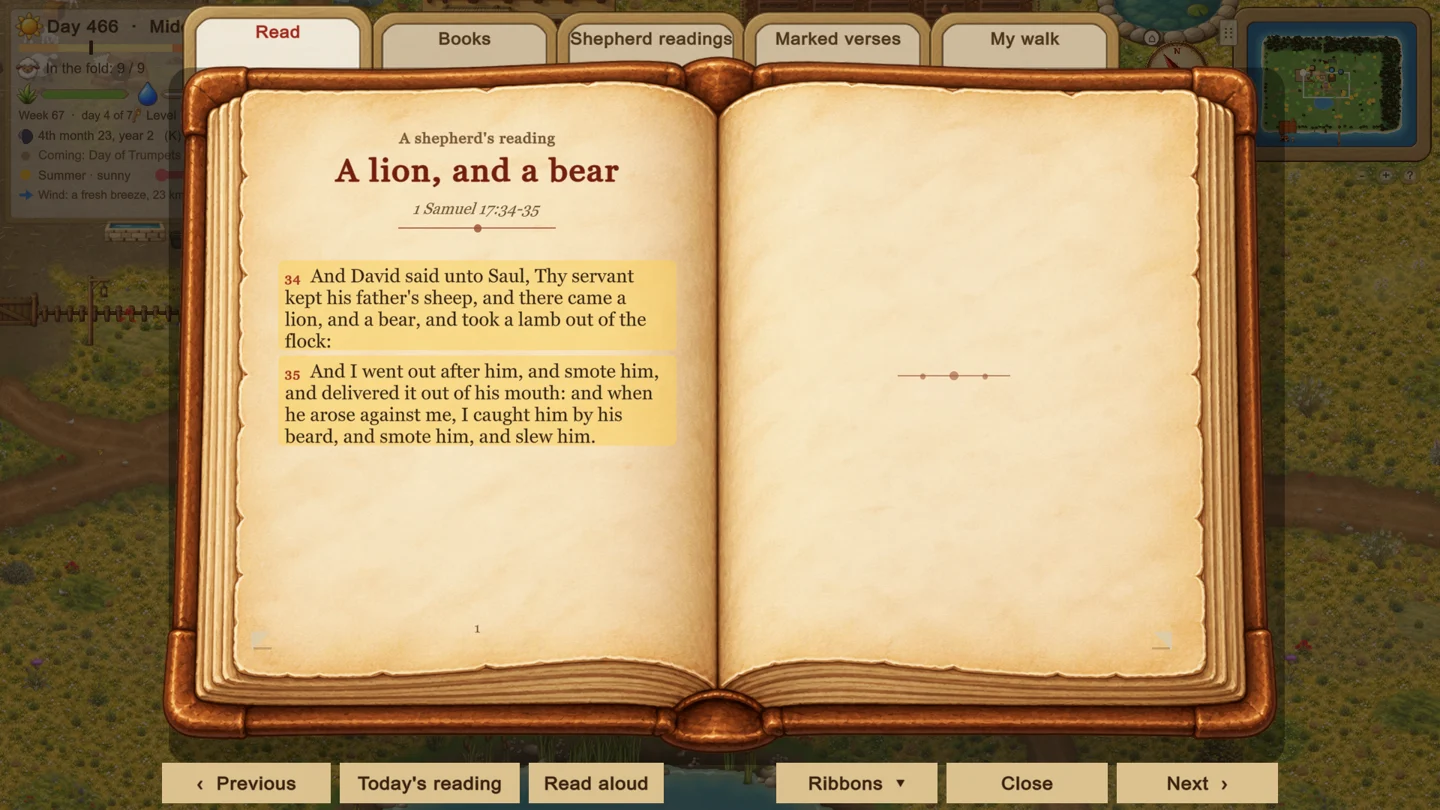
F at the reading stand in your house opens the book where you left off.
Turn the page. A / D (or the arrows), the Previous / Next buttons, or click the curling corner at the outer edge of a page. At the end of a chapter the next one begins.
TABS along the top: Read, Books (every book of the Bible - pick one, then a chapter), Shepherd readings, Marked verses, and My walk.
Ribbons. three silk ribbons (red, blue, green). Ribbons > Place here marks the page you're on; their tails hang out of the bottom of the book - click a tail to open there.
Mark a verse. click it and it turns gold; all your marked verses are gathered under Marked verses.
What reading gives. read a chapter or reading through (every page, at an easy pace) and it counts as a day in the Word - you feel refreshed and tire more slowly that day, and the days in a row are counted. New chapters grow your shepherd skill (the first three each day), and every book read through presses its seal in My walk. It's never a chore - the chores board just notes it quietly.
The Name is restored as in Torah Keeper. How a plain "Lord" reads in the New Testament (Master or Yahuah) is your choice, under My walk.
↑ Back to handbookCHAPTER 16
AFTER EACH BUILD the hammer is put away and the panel closes, so a stray click can't build a second one - press the hammer's key (8) or click its slot to build again.
Moving the farm. with the hammer, click your house, the hen house, the sheepfold, the garden, the fish pond or the campfire - it lifts: an outline the size of its ground follows the mouse, green where it fits, red where it doesn't (and why). Click where it should go and it moves there and then (#255 - no setting the valley up again): the door and the rooms, the well and the yard with the house, the whole sheepfold with its fence, floor, gate, lantern, hay, shelter, goat shed, hen house and the sheep inside, the hens with their hen house, the beds and a new fence with the garden; the game is saved. The outline is the size of the building's own ground, so it can go right up beside things. Right-click leaves it where it was. ROOM TO BUILD: building, digging and new beds are kept off only what's really there - the farm's buildings by their own ground, the water's edge, the path, a bed - not a wide ring round them; it says what's in the way (a tree - chop it down first - a rock, something you built). NOTHING GROWS BACK on your beds, paths, buildings or dug water. PATHS THAT MEET (#255, #257): lay a path onto another of the same dirt - or a packed-earth path onto the valley's own trail - and they join into one path where they meet, no edge line between the two; over a different dirt the line is soft. The green outline follows your drag the whole way, over trees, flowers and the dog, drawn on top so thick grass never hides it. THE TOWER OF THE FLOCK always faces you with its ladder up the middle, and doesn't turn. THE VALLEY'S TRAILS: the hoe's Take up a path takes up a stretch of the valley's own trail too - lay your own paths wherever you like; Bring back the valley's trails puts them all back.
Campfires. four looks - the first stone ring, the limestone ring, the rustic log fire and the low ember hearth. Click a campfire with the hammer: Look goes to the next; the look you choose is the next campfire's (and the one by the trail takes it too). Their flames are alive: the painted flames flow and lick upward, the light breathes, and sparks rise and drift away - more of them at night.
Building in stages. the big things - the tower of the flock, the work shed, the growing house and the booth - are built the real way. With the hammer you MARK OUT where it goes (pegs and a cord round the ground: a building site; nothing is used yet). Then click the site: its next stage shows what it needs (stones for the base, oak for the beams...) - choose it and he works on it, stroke by stroke, and the building rises from its footing (the faint finished shape shows what you're building). Walk away to stop: the site waits, and a stage you began keeps its materials. The last stage done, it's finished and works. Take the site down (click it) and everything put into it comes back. Small things are still built at once. The Admin panel's "Build big things in stages" turns it off (built whole, as before).
Fruit from the trees. the valley's wild fruit trees bear in their season - FIGS (early to late summer, months 4-6), ALMONDS (early and high summer, 4-5), CAROB pods (high summer to early autumn, 5-7), POMEGRANATES (late summer and early autumn, 6-7), DATES on the palms by the water (late summer to autumn, 6-8) and OLIVES (autumn, 7-9). The month before, the fruit hangs green. Walk up to a tree in fruit and press F (or click it) to pick it into your bag (a click anywhere on a tree in fruit - its trunk too - picks; it never takes the axe up by itself to chop it, #280. To chop a fruit tree in fruit, take the axe up first - with the axe in hand, a click chops). A picked tree bears again a week later while its season lasts; not every tree bears. Figs, almonds, pomegranates, carob and dates are food (Eat in the bag); olives are bitter off the tree - keep them for the olive press, to come. Point at a tree to see when its fruit ripens. No picking on the Sabbath.
The camera. Esc > Display > Comfort. 'Camera follows him' - close behind, normal, or soft and slow. 'The view when the game starts' - as now, your last zoom (whatever you scrolled to), or your own (a slider from close to very wide). The mouse wheel zooms, middle-drag looks around, C brings the camera back, Tab shows the map.
The mouse. Game settings > The mouse sets how fast the mouse moves things - the spyglass, dragging to look round, swimming under the water (tilt and turn) and lying back under the sky - each on its own, from 0.2x to 4x.
The beach. crabs scuttle sideways over the sand - come close and they raise their claws and dig in, then come up again later; hermit crabs pull into their shells; sandpipers run along the water's edge, peck, and dash off together when you come; gulls waddle about the sand pecking for food, sit and preen on the posts by the water, and wheel over the shore in wide circles (watch their shadows on the sand) before coming down on a free post or the beach - walk at them and they take off (#291, #292); a heron stands at the water's edge striking at fish and stalks off if you come close. Look for starfish, sea urchins, seaweed, tide pools, shells and driftwood on the sand, and a coil of rope and a fish basket on the jetty (crates and barrels on the big dock).
Berry bushes. about the valley grow BRAMBLES by the water (blackberries, early and high summer, months 4-5), MULBERRY bushes (late spring and early summer, 3-4), CAPER bushes (their buds, spring, 2-4) and HAWTHORNS (little orange haws, early autumn, 7-8). Green the month before; walk up and press F (or click the bush) and he kneels and picks them into his basket. A picked bush bears again a week later while its season lasts. All of them are food.
A new house. with the hammer, choose New house and mark out where it goes - beside the house you live in, with room for its well. Click the site: before the foundation you choose its DESIGN (< and >: the menu shows its picture and the house on the site shows it - any of the sixteen that are painted). Then four stages: lay the foundation (16 stones), the walls to the sills (16 stones, 4 wood), the walls and the roof beams (10 stones, 6 wood, 3 oak), the roof, the door and the shutters (8 wood, 6 straw). When the last is done your house moves there in its new look - its rooms, everything in it and the well go with it - and the old spot grows grass. One new house at a time; a house is always built in stages.
Take the HAMMER (8). A panel opens on the right, under the map: a row for each thing you can build there, with its picture and what it costs (grey = you haven't got enough yet) - scroll it when the list is long; the line under the list says what the chosen one is for. Outside it shows the valley's things, in the house the furniture, in a barn the barn's things.
Point where it should go: a see-through copy follows the mouse - green fits, red doesn't (the words say why: the path, water, the fold, something in the way...). CLICK and the shepherd walks over and builds it. RIGHT-CLICK something you built to take it down - you get everything back.
CAMPFIRE (2 wood, 4 stones): warm up, cook and bake out in the hills; it lights the night. LOG BENCH (2 wood): sit and rest. LANTERN POST (2 wood, 1 stone): a light by the path after dark. CLAY OVEN (2 wood, 6 stones): bake and cook outdoors. WATER TROUGH (3 wood, 2 stones): the flock drinks there - handy far from the pond. BOOTH / SUKKAH (10 wood): sit in its shade (Leviticus 23:42) - during the Feast of Booths you may build it even on the feast's days of rest, it counts as your booth for the feast, and at night you sleep in it. TOWER OF THE FLOCK (6 wood, 12 stones): stand at it and your whistle carries 60% further (Micah 4:8).
BEEHIVE (2 wood, 4 stones): a stack of clay hives - see Bees and honey.
Furniture. take the hammer (8) INSIDE YOUR HOUSE and the menu shows furniture: STOOL (1 wood) and BENCH (2 wood) to sit on, SMALL TABLE (3 wood), CHEST (3 wood - opens your bag), WALL SHELF (2 wood, on the back wall), OIL LAMP (1 wood, 1 stone - lit in the evening), CLAY JARS (4 stones), WOVEN RUG (3 yarn - from your own wool), WOOL BASKET (1 wood) and SPINNING WHEEL (5 wood). Place it the same way: point at a spot - the see-through piece gets a GREEN outline and a frame on the floor where it fits, RED where it doesn't (and it says why) - and click. Click one you made to Move, Turn or Take it down (everything back). TURN (or Z while placing): a piece with a side view turns a quarter at a time; the rest face left or right. THE HOUSE'S OWN FURNITURE can be moved too: click the table (its benches, candles and work spots go with it), the bed, the chest, the loom, the reading stand, the lamps, the wool basket, the rugs, the shelves and the stools and choose Move (the chest can face the other way too). They can't be taken down. The oven, the hearth, the storage jars and the finds shelf keep their places.
THE UPPER ROOM (12 wood, 10 stones, one only): in the house's main room, build the ladder against the back wall and climb it (F or click) into a new room above, with two windows to the sky and a lamp for the evening. Furnish it with the hammer just like downstairs; the way down is the ladder in its corner (Mark 14:15, Acts 10:9).
Workshop. build a WORKBENCH in your house with the hammer (4 wood, 1 stone), or a WORK SHED out in the valley (16 wood, 10 stones, one only - walk in at its open front; its long bench is at the back, the tools on the wall). At a bench, pick what to make: the everyday tools (AXE, PICKAXE, HOE, SHOVEL, HAMMER), SHEARS, a SMOKE POT, a RAKE, a PITCHFORK, a MANURE SHOVEL, a HAY BALE (3 straw), an ICE CHISEL or a SNOW SHOVEL. A tool's head or edge can be made of FLINT, STONE or WOOD (cheap, wears out soonest), COPPER (2 copper ore) or IRON (1 iron ore, lasts longest), and an OAK or TEREBINTH handle lasts longer still - choose under the recipe; it says how many strokes the tool will last. Making it is a little game: each step (hammer, grind, saw, carve...) a marker swings along the bar - press F, Space or the button while it is in the GREEN (the bright middle is a sweet stroke); one stroke a step. A stroke outside the green is a slip. No slips = finely made. The rake, the pitchfork, the manure shovel, the snow shovel and the ice chisel go on your TOOL BELT (keys 1-9). Nothing is used up until it is made; Esc or Put it down stops. No work at the bench on the day of rest.
Carrying things. F on a clay jar, crate, barrel, basket, bucket, log seat or hay bale and he lifts it up over his head. Then F sets it down in front of him; CLICK where you want it (a see-through copy shows where - green fits, red doesn't) and he walks over and sets it down there; RIGHT-CLICK throws it there (up to 6 m - it lands short of water and walls); B puts it in your BAG. In the bag, TAKE OUT lifts one out again wherever you are (a hay bale bound at the workbench too); a hay bale can be SPREAD from the bag with the pitchfork. The panel over the toolbar shows the same choices while you carry something. THINGS THAT BREAK (jars, crates, barrels, baskets - on the farm and in the mine): clicking one (or F) shows a little menu: PICK UP or BREAK OPEN (there may be something inside); thrown, they break where they land. A farm one comes back to its place a few days later. A HAY BALE's menu has Pick up, Break apart and Spread (with a pitchfork); thrown, it bursts into LOOSE HAY - the pitchfork spreads that in the fold or a barn, or gathers it up as straw anywhere else. The little menus float above things and stay faint until the mouse is on them (Settings, Display: how faint, how high).
Tools wear out. every stroke with the axe, pickaxe, hoe, shovel, hammer, rake, pitchfork or manure shovel, and every sheep shorn, wears the tool a little - the bar under each tool on the toolbar (and the % in the bag) shows its life. At a quarter he tells you; at nothing it BREAKS and leaves the belt - make a new one at a workbench (a half-worn one can be replaced any time). SPARE TOOLS: at the workbench, a tool you already have in good shape can be made again - the new one goes in your bag as a spare (up to three of each), and when the one in your hand breaks a spare takes over at once, so you keep mining. Iron lasts longest, then copper, then flint / stone / wood; an oak handle and a finely made tool (no slips in the strike game) last longer. The tools you start with are old but sound. Point at a tool on the toolbar to see what it does, its life left and what a new one takes.
The barnyard. every night manure heaps up where the animals are (most of it INSIDE the sheep shelter, the goat shed and the hen house - walk in; the chores list says where each heap is and its arrow points at the door, #262) - the fold, the goat shed, the sheep shelter, the hen house. Shovel it up with the MANURE SHOVEL (E, or click a heap): it feeds a watered garden bed like bat guano, or goes in the COMPOST BIN (the hammer, outside: 3 wood). The same shovel scoops the bat guano in the mine. HAY BALES stand in the barns (and by the sheep shelter): F lifts one up to carry it (see Carrying things). With the PITCHFORK in hand, F on a bale (or E with a bale in the bag, in the fold or a barn) SPREADS it: the animals there eat well for 3 mornings, a full belly even in the snow. Bind new bales from 3 STRAW at a workbench - straw comes with every barley or wheat harvest, and from raking the dry grass in summer. The RAKE (E): fallen leaves in autumn, dry grass in summer. The compost bin takes manure, leaves and straw; when it is full (6) it rots down into 3 COMPOST, the best feed for the garden - in 5 days, or quicker with LEAVES in the mix (a day less for every 2 armfuls, as little as 2 days). Gather leaves with the rake (a pile under a tree gives 3) or by hand (F on a pile: 2). Compost worked into a watered bed makes the crop grow a day faster every day till harvest. In the barns the hammer builds a feed trough, a water trough, a lamp, a stool, a bench, clay jars and a basket.
Paint & finish. with the hammer in the house (or the upper room), click the last row of the build panel, Paint & finish, then click a piece of furniture you made, the back wall or the floor and choose its finish. WOOD: natural, dark oil, walnut (1 wood), red ochre (1 stone), olive green (1 herb), indigo blue (1 yarn). THE RUG: natural wool, or dyed madder red, indigo or saffron (1 yarn). WALLS: cedar, whitewash, ochre plaster or blue-grey lime (2 stones). FLOOR: cedar boards, beaten earth (1 stone) or stone flags (6 stones). Press the button again to go back to building.
Wood. chop trees with the axe (point at a tree to see what it is and what its wood is good for) - each tree gives its OWN WOOD (olive, oak, terebinth, almond, carob, fig, pomegranate, date palm, tamarisk). Any wood burns and builds as firewood (the common kinds are used first, olive and almond last). Some things need a particular wood: the work shed and the tower of the flock take OAK beams, the booth (sukkah) takes PALM fronds; and Paint & finish has olive-wood, oak and almond finishes for your furniture. Firewood: chop trees with the axe. Stones: break them off rocks with the pickaxe. No building on the day of rest.
↑ Back to handbookCHAPTER 17
BEES work the flowers in the meadows on fine days (not at night or in the rain) - listen for their hum.
Wild honey. wild bees nest in cracks in three of the big rocks - look for the bees and a drip of honey. Walk up and press F (or click) to take the comb. The comb is back about a week later ("honey out of the rock", Psalm 81:16).
The smoke pot. without it the bees sting you (it tires you) and you grab only one comb. Make one at a campfire (1 wood, 1 stone) once you've met the bees; with it the bees stay calm and you take all the comb.
Your own hives. build a BEEHIVE with the hammer. A swarm moves in by the next morning; then the bees make honey every day - faster with flowers near and in fine weather - up to 4 combs. When there's comb to take, more bees buzz at its mouths. Point at it to see how far along it is.
At the table at home. press the honeycomb into jars of honey and cakes of beeswax; roll 2 beeswax into 2 beeswax candles. Whatever comb, honey, wax and candles you're carrying stand on the table, and the press is at the table's right end. The Sabbath candles use them when you have some.
Honey and honeycomb are good to eat. No hive work on the day of rest.
↑ Back to handbookCHAPTER 18
YOUR BED (in the sleeping room at home): click it and a little box asks what you'd like.
SLEEP FOR THE NIGHT (in the evening, with the flock in the fold and the gate shut): you stand by your bed, lift your hands and look up, and pray the prayer Yahusha taught us (Matthew 6:9-13) - Alt shows the next line, Esc finishes. Then you lie down, your animals in the room lie down round the bed with you, and you fall asleep.
LIE DOWN AND REST (any time): you lie on your bed and rest comes back while the day goes on. Your animals lie down with you. Any move key gets you up.
Pray. the same prayer, any time you like.
The morning. when you wake, before anything else, pray (click your bed: Morning prayer) and read the Word (the book on its stand). Do both before you go out of the house and the day is BLESSED: hunger, thirst and tiredness come on 20% slower all day - and a little slower still for every morning in a row, up to a week. Nothing is lost if you don't - it's there to help you make it a habit.
↑ Back to handbookCHAPTER 19
IVORY is your sheepdog (Hebrew Shen, "ivory" - as in Solomon's throne of ivory, 1 Kings 10:18). Ivory works the flock with you (R, Shift R, U, X, Y) and learns by working.
PETS FOLLOWING (Game settings > "Pets follow you on their own"): ticked, your pets follow you everywhere as before. Untick it and Ivory, Gizmo and your tame animals stay where they are - tell one to come along (Shift+click a pet, click your deer, X for Ivory, or two quick whistles for all of them) and it follows you till you tell it to stay again. Animals you tame while it's unticked wait where they are.
GIZMO is your house cat: he lives INSIDE your house, usually curled up by the hearth, and he's there when you come in. Shift+click him in the house and he comes along with you (out the door too); Shift+click him again (inside or out) and he goes home to the house. The other cat lives by the house outside. Click a cat to pet it: he kneels beside it and strokes it. SHIFT+CLICK a cat to have it come along with you, or Shift+click again to tell it to stay. Two quick whistles (Alt Alt) call all your pets.
Pets that are with you come into the house (and the sheds) with you and out again. Click one to pet it - indoors too; it holds still and a little note shows over it. When you lie down on your bed they come and lie down with you.
The other dogs and cats you meet are the farm's own.
DEER live in the woods. Walk up to one slowly (running scares them) and feed it a herb (F, or click it) - after five it trusts you and follows you. Click your deer to tell it to STAY where it is, and click again to have it COME ALONG. Your deer follow you while you're near the woods; when you head home to the farm they go back to the edge of the woods and wait for you there. Deer leap over fences.
↑ Back to handbookCHAPTER 20
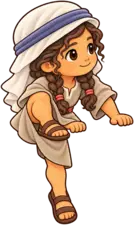
Swim. walk into deep water. W/A/S/D swim, Shift swims faster (it tires you). Ctrl takes you under (hold it to go deeper), Space brings you back up. Watch your breath - the bubbles over you; come up for air, or rise into an air pocket and stay a moment to fill your lungs. Swimming fast under the water uses breath faster.
THE BIG POND goes down: a shaft of rock in its middle leads to a great flooded hall under the farm. Air pockets under the hall's roof let you breathe. A glowing tunnel on its far side leads on to the mine pool once the way is open. OLD FINDS lie on the hall's floor - look for a soft gold glimmer: swim down to one and press F to take it (an ancient jar, oil lamps, silver shekels, a painted shard, a pearl in a shell). New ones lie there after a few days. The middle shelf in your house shows what you've found.
The mine. its entrance is at the edge of the north woods (Tab: "Mine" on the map). Break rocks with the pickaxe for stone, flint, ore and crystals (click a rock once and he keeps at it till it's done - click it again to stop); one rock on each level hides the ladder down. Scoop up the bat guano with the manure shovel (the heaps with flies and a faint glow) - spread it on a watered garden bed and the crop grows an extra day every day.
OLD BARRELS, CRATES, POTS AND BASKETS stand by the house, the goat shed and the campfire, and the miners left some in the mine: walk up and press F (or click one) to break it open - often there's something inside (grain, seeds, figs, herbs, wood; ore or an old coin in the mine). The farm's come back a few days later. Not on the day of rest.
GOING HOME, AND BACK: click the compass for a list - Go home, the mine levels you've been down to (straight back to the deepest), the mine's mouth, the big pond, the sea by the dock and your work shed once you've been there. Click one and you go (swim to the shore first).
↑ Back to handbookCHAPTER 21
Each special day has things to do - the chores panel (J) lists them, with the way to each. Every one gives a verse and grows your shepherd skill.
Every sabbath. share the Sabbath meal (F at your table, with some food in your bag); read the Word (F at the reading stand); WALK AND SEE - stand still near an animal or bird for a moment and it's written into your creation journal (how many kinds can you find?); at sundown, watch the stars come out (L lies you back to look at the sky).
The new moon. in the evening, look for the first thin crescent in the western sky (L). On every new moon and every high day of the appointed times you may also BLOW THE SHOFAR at the campfire - "Blow up the trumpet in the new moon, in the time appointed" (Psalm 81:3): it's on today's chores as an optional bonus (+2 skill).
Passover. search the house for leaven - six crumbs to find (they glint) - then burn it (F at the campfire - he throws the pieces into the flames); in the evening keep the Passover meal at your table (what is on it follows your household's table - menu > Sabbath and calendar; the verse is always shown as written). UNLEAVENED BREAD (seven days): bake it at the oven (2 grain).
Firstfruits. lift up the first sheaf of barley at the campfire (barley in your bag). THE FEAST OF WEEKS: lift up two loaves of bread at the campfire.
The day of trumpets - the shofar game. F at the campfire. Calls slide toward a line; press Alt (or click) just as each one reaches it - every press blows the horn - the real ram's horn: a call in time sounds its own blast (long, medium or a quick burst), a press off the beat a short low blat (#268, #270). Ten calls - seven in time and the shofar's blast rings out over the valley. Miss too many and try again.
The day of atonement. a quiet day of fasting and prayer - your food bar holds, and you don't eat.
The appointed times. hover over the day at the top left (or the chores strip on a day of rest) to see what the day is; click it for its card. The card also opens by itself as the Sabbath begins and on the morning of a feast or a new moon (Game settings: "The appointed times' cards open by themselves"). Or open the calendar (C) and click any Sabbath, new moon or feast - or the "Appointed times..." button - for its card: what it is and how the Scriptures say to keep it, every line with its verse (Leviticus 23 and the rest). On every calendar path. WAVING: at Firstfruits he waves the first sheaf before Yahuah, at the Feast of Weeks the two loaves, and each day of Tabernacles he takes up the four kinds - palm, willow, myrtle and citron - and rejoices (F at the campfire, once a day). THE FEAST TABLE: on a day of rest and on a feast day the house table is laid with bread (matzah through Unleavened Bread), cheese, figs, honey, stew and leben; at Passover matzah and bitter herbs - and the roast lamb if your household eats meat (More choices > Your household's table). THE SHOFAR is in your bag: "Blow" it any time to practise; on the Day of Trumpets, a new moon or a high day it counts as the day's blowing. YOUR HOUSE (Game settings > Your house): the first house or any of the fifteen designs - House A the limestone family home, B the courtyard homestead, C the earthen village home, and Houses 01 to 12 (the stepped terrace, the U-shaped court, 03, the split level, the mudbrick archway, the timber veranda, the compact tower, the breezeway, the rounded earthen home, the workshop and loft, the garden roof, the coastal loggia); each grows a second storey when you build the ladder to an upper room, and the door is wherever that house has it. CALENDAR PATHS: on the Sunday path you rest on the Lord's Day and the Torah's feasts are ordinary work days - they still show, with their Scriptures, and their things to do are marked optional; "No days kept" makes every day a work day, with the same Scriptures and cards to read.
Tabernacles. build a booth of branches beside the house (4 firewood, F there) and sleep in it; find the four kinds hidden round the valley - a palm branch, willow of the brook, myrtle and a citron.
Other games. MILKING - lead her to the milking stand (F); a marker swings: press A when it's on the left and D when it's on the right, in turn, and the pail fills (see Lambs and milk). FISHING - wait for a bite, then hold to reel and let go when the line pulls too hard. STARGAZING (L) - the real stars and the moon; A / D turn you round.
↑ Back to handbookCHAPTER 22
The SHOFAR sounds three times: on the morning before a day of rest (get food and firewood ready today), when the sun gets low (go home and light the candles), and when the rest begins at sundown.
Light the candles on your table (F) late on the preparation day, before sundown.
On the day of rest the flock stays in the fold (a whistle won't call them out - the game tells you so; on the lunar-solar path a new game begins on the new moon, a day of observance, so the flock stays home on day 1), and there is no work: no digging, sowing, building, chopping, fishing or cooking. Going out to find a lost sheep is always allowed.
Feast days. the bottom line of the status panel (top left) shows the appointed time you're in ("Today: Unleavened Bread, day 2 of 7") or the next one coming ("Coming: Passover in 5 days"). The calendar (K) lists them all.
Your household's table. keepers differ on eating flesh, so you choose - no flesh (grain, fruit, herbs and milk, as in Genesis 1:29) or clean meat as the Torah allows (Leviticus 11). It is chosen when you set up a new game and can be changed any time (menu > Sabbath and calendar).
K opens the calendar: the moon, the rest days and the feasts. Which days you keep is chosen when you start a new game and can be changed any time in the menu - no penalties either way. The paths: WEEKLY seventh-day Sabbath (months by the moon you see); the HEBREW (Rabbinic) calendar (the calculated months and the 19-year leap cycle, Shavuot on the 6th of Sivan); LUNAR Sabbath; LUNAR-SOLAR; SOLAR 364-day; and SUNDAY, the Lord's Day (rest on the first day; the feasts by the moon).
MORE CHOICES (on the Sabbath and calendar page): when the month begins (the first crescent, the dark moon or the full moon), what begins the year (the barley, the first new moon after the spring equinox, the new moon nearest it, or Passover after it), when the day begins (sundown, or sunrise / midnight), the count to Shavuot (from the weekly Sabbath, or from the 16th), whether the new moon is a day of rest, the solar year kept by the sun, Purim and Hanukkah on the calendar, milking on the day of rest and your household's table.
Lunar-solar. the year begins with the first new moon after the spring equinox. Every month begins at the new moon - a day of observance (no ordinary work, the flock stays home, but not a Sabbath). The weeks start on the 2nd, so the Sabbaths are the 8th, 15th, 22nd and 29th, and the 30th (and 31st) stand between the weeks. The seasons end on the equinoxes and solstices - the 31st days of months 3, 6, 9 and 12 - and the spring equinox is the year's last day. On this path the sky keeps the same calendar: the moon is new on each 1st and full at mid-month, and the sun reaches each equinox and solstice on the 31st. On every path the equinoxes and solstices are marked on the calendar and shown with Genesis 1:14 when they come.
L: lie back and look at the sky (A / D to turn) - the real sun and clouds by day; by night the Milky Way, the stars and the moon in their true places. The pond and the sea take the sky's colour and the sun's glitter (no clouds in the water), and in the morning and evening sun shafts slant across the valley (Game settings).
↑ Back to handbookKEYBOARD AND MOUSE
Press H in the game for the Controls window. To change a binding, open Esc → Controls → Change keys, select a key and press the new one. Usual keys restores the defaults.
| Control | What it does |
|---|---|
| W A S D | walk (hold Shift to run - and to swim faster; it tires you) |
| Click | walk / use (click mode) |
| Wheel | zoom in and out |
| Middle-drag | look around |
| C | back to the shepherd |
| Tab | map of the valley |
| Esc > Display | the camera: the view when the game starts, how it follows |
| F | lift jars, crates, barrels, baskets, hay bales |
| Carrying | F down in front · click: down there · right-click: throw · B: into the bag |
| O | sit down / get up (rest) |
| Space | jump (running: a long leap) |
| Click compass | go straight home (not while swimming) |
| Control | What it does |
|---|---|
| F by a boat | (swimming) climb aboard - ships: up the rope ladder |
| F on the jetty | step into your own boat (on the wharf: the trading boat) |
| W / A / S / D aboard | walk about the deck |
| F at the stern | take the tiller / helm (ships: up on the stern deck) |
| A / D (helm) | steer to port / to starboard |
| W / S (helm) | more / less sail (stopped head to wind: W rows) |
| Shift (helm) | haul hard: faster, uses your stamina |
| F (helm) | let go (beside the jetty: she's tied up) |
| Space aboard | jump off over the side |
| The wind | the status panel's wind row · at the helm: the gauge over the boat |
| Sailing | across the wind is fastest; straight into it: in irons |
| Control | What it does |
|---|---|
| Alt | whistle the sheep to you |
| Alt Alt | two quick whistles: call your pets (Shift+click a pet: stay / come) |
| 0 | empty hands: put the tool away (a tool key takes one up) |
| Ctrl (deep water) | dive under / go deeper |
| Space (under water) | go up |
| Mouse fwd / back (swimming) | tilt down / up |
| E | hold the staff to push sheep |
| G | open / close the fold gate |
| R | dog: gather the flock |
| Shift R | dog: take them home |
| U | dog: out of the fold to graze |
| X | dog: stay / come |
| Y | dog: fetch that one (trained) |
| Control | What it does |
|---|---|
| F1 | the Keeper's Book: your journey, goals, skills, the flock, the cookbook, the field guide, records |
| J | today's chores |
| K | calendar: moon, Sabbaths, feasts |
| L | lie back and look at the sky: sun, clouds, stars, moon |
| A / D | (sky) turn round |
| E (spyglass) | raise / lower the spyglass |
| Mouse, W / A / S / D | (spyglass) look round · wheel: closer |
| Hold it on a boat | (spyglass) spot it - Keeper's Book: Sightings |
| L, then E | (spyglass) look up through it at the sky |
| L (glass up) | (spyglass) look out to the horizon |
| Control | What it does |
|---|---|
| 1 - 9 | the tools on your belt (bag B: change them) |
| Q | next tool |
| E / Click | use the tool in your hand |
| F | use / pick / feed what's near you |
| Right-click | reel in the line |
| Control | What it does |
|---|---|
| B | bag: eat, choose seeds |
| F | bed: sow, water, harvest |
| F | well: drink and fill your jar |
| Workbench | a bigger water jar: large clay jar 12, a jar on a carrying stick 20, two jars on a yoke 32 - or find one: a pot in the mines, an old jar in the flooded hall |
| F | fish pond: let fish go |
| Hoe, click | dig a bed · Z: fill in, lay a path |
| Laying a path | drag: the shape glows green where it can go, red where it can't · pick earth or laid stone (cobbles, limestone slabs, crushed limestone, river pebbles) above the bar |
| Click a rock | the pickaxe breaks stones off it - he keeps at it till you click again |
| Hammer, click | build · Z turns · click one: its menu |
| Shovel, click | well, pond, fill in (Z) |
| Fence, drag | a run or a box |
| Fence, right-drag | take fences up |
| F | hen house nest: set an egg |
| Click / F | lead a ewe or goat to milk |
| Click your bed | sleep, lie down and rest, or pray |
| Click Ivory / Gizmo | pet them (Shift+click Gizmo: stay / come along) |
| Mouse over the bag | what a thing is for and where it's found |
| Control | What it does |
|---|---|
| H | show / hide these controls |
| V | hide EVERYTHING on screen (V again: back) |
| Esc | menu |
| Esc > Display | screen, quality, details, size of each panel and the menus |
| Drag the grip | move a panel · its little x hides it |
| [ ] , . M | volume, music, mute |
FOLLOW THE GAME
Wishlist Shepherd’s Keeper to follow the PC release. The game is being developed as a single-player experience, with multiplayer planned.
View the Steam page → Play the browser activities